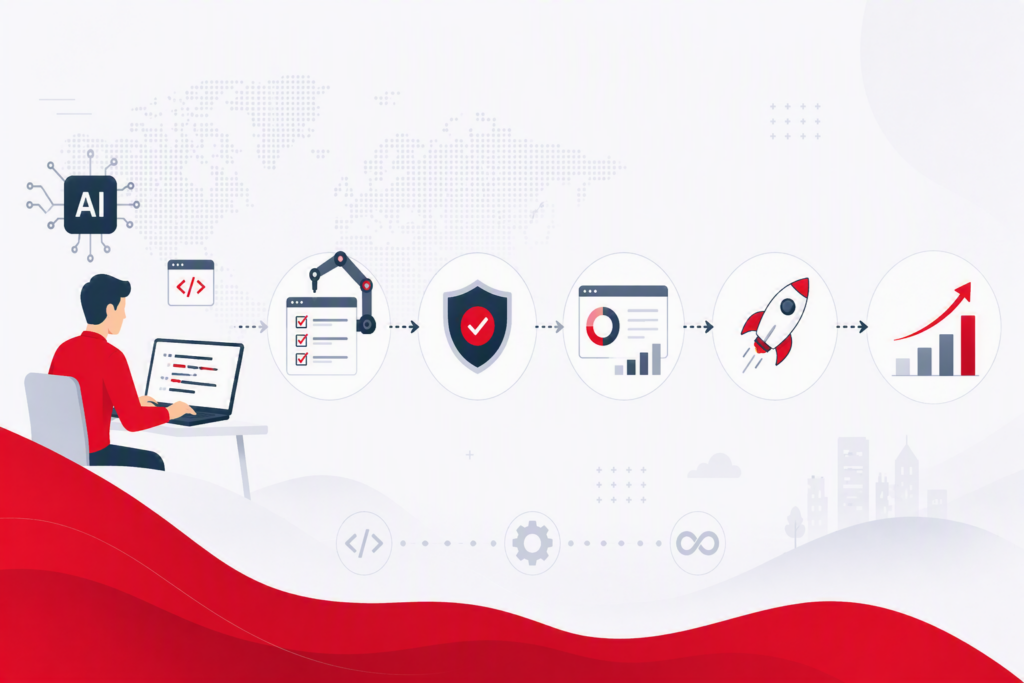
Software development outsourcing has changed a lot in the last few years. Five years ago, cost reduction was the primary driver behind outsourcing. Today, the reasons look different. Teams outsource because they need faster product delivery, access to engineers with AI skills, specialized expertise, teams that can scale up or down, better software quality, and coverage around the clock.
AI coding tools have made writing software faster, but experienced engineering teams are still essential. Production-ready software requires strong architecture, security, testing, DevOps, governance, and ongoing maintenance. Faster code generation does not replace the experts who plan, build safely, and maintain systems.
Today, organizations are less concerned about whether to outsource and more focused on finding partners who blend AI-driven productivity with strong engineering, security, governance, and long-term support.
Whether you are building a new SaaS platform, modernizing legacy applications, integrating artificial intelligence into your products, or expanding your engineering capacity, outsourcing can provide significant advantages when approached strategically.
This guide covers what decision-makers need to know before outsourcing software development, from defining your goals to maintaining a healthy system after launch.
What Is Software Development Outsourcing?
At SHIFT USA, we believe software development outsourcing is no longer just about expanding engineering capacity. The right partner should improve software quality, reduce delivery risk, and help organizations deliver software with confidence.
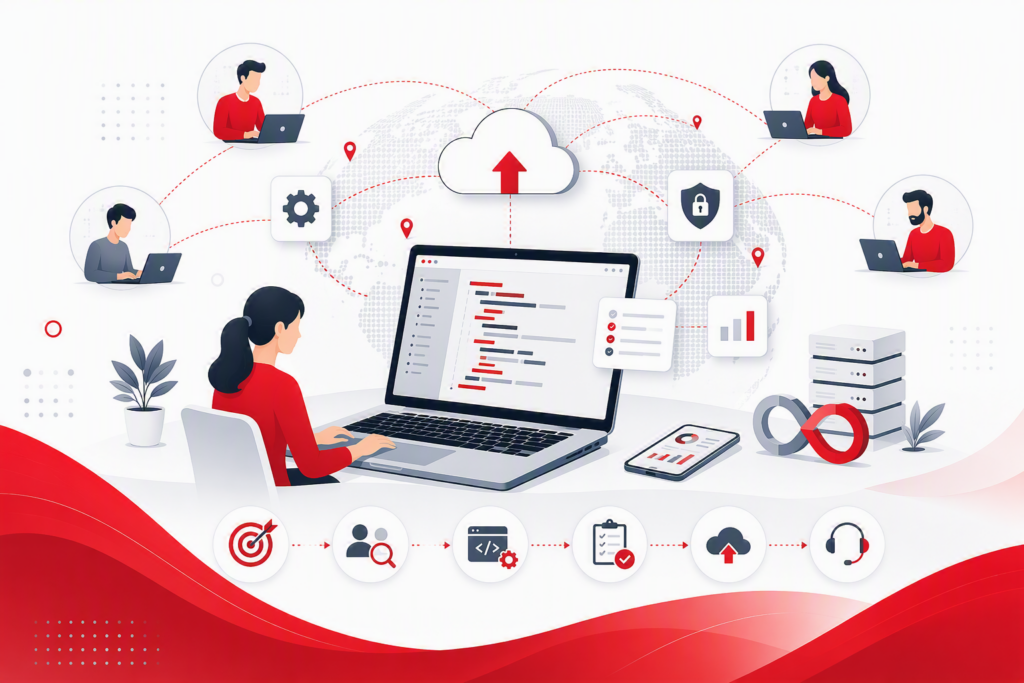
In its broadest sense, software development outsourcing involves partnering with an external engineering team to support some or all stages of the software development lifecycle—from planning and design to development, testing, deployment, and ongoing maintenance.
Over the past decade, outsourcing has evolved far beyond coding or offshore development. Today, organizations increasingly rely on outsourcing partners for strategic capabilities such as product discovery, cloud architecture, DevOps, AI integration, cybersecurity, quality engineering, and ongoing support.
It helps to know the difference between a few related terms:
- Outsourcing covers the full delegation of a project or function to an external partner.
- Staff augmentation means adding outside engineers to your existing team, under your management.
- Managed development means the partner runs the day-to-day work, with you setting direction and priorities.
- Dedicated teams are outside engineers who work only on your product, functioning like an extension of your team.
- AI-assisted development means the outsourcing partner uses AI coding tools inside their normal process, with engineers reviewing and directing the output.
Almost any part of the software lifecycle can be outsourced, including product discovery, UI and UX design, backend and frontend development, mobile apps, QA testing, DevOps, cloud migration, AI integration, and ongoing maintenance.
Several trends are shaping outsourcing in 2026. AI-assisted development is now standard, cybersecurity rules are stricter, and more companies want enterprise modernization. Cloud-native development, platform engineering, and DevSecOps are on the rise. Companies are looking for partners who focus on software quality, not just output. Outsourcing is becoming a strategic partnership, not just a way to save on labor.
Why Companies Outsource Software Development
Faster time to market. Outsourcing removes hiring delays, enables parallel development streams, provides access to reusable engineering frameworks, and accelerates coding with AI assistance where appropriate.
Access to specialized talent. Many companies cannot hire and retain AI engineers, cloud architects, cybersecurity specialists, QA automation engineers, DevOps engineers, and mobile experts fast enough on their own. An outsourcing partner already has these roles filled.
Cost optimization. Outsourcing usually brings lower hourly rates, less spending on recruitment and infrastructure, and more predictable budgets. However, the cheapest option rarely offers the best value. A low-cost partner who misses deadlines or delivers buggy code can end up costing more overall.
Flexibility. Teams can scale up or down without the lengthy hiring and firing cycle.
Risk reduction. A good outsourcing partner brings architecture reviews, quality assurance, compliance expertise, security testing, and disaster recovery planning that many internal teams lack the bandwidth to maintain consistently.
Understanding Different Outsourcing Models
Although the terms are often used interchangeably, there are important differences between common outsourcing approaches.
Software Development Outsourcing
An outsourcing partner takes responsibility for delivering a project or business function, including planning, development, testing, deployment, and ongoing support. The partner manages day-to-day execution while working toward agreed business outcomes.
This model works well for organizations seeking end-to-end delivery with minimal operational overhead.
Staff Augmentation
Staff augmentation adds external engineers to an existing internal team. The client retains responsibility for project management, sprint planning, and technical direction.
Companies often use this approach to fill skill gaps or boost development capacity without hiring permanent staff.
Dedicated Development Team
A dedicated team functions as an extension of the client’s engineering organization. Team members work exclusively on the client’s product over an extended period while adopting the client’s workflows, communication practices, and product roadmap.
Dedicated teams work especially well for long-term SaaS products, enterprise modernization, and platforms that are always evolving.
Managed Software Delivery
Under a managed delivery model, the outsourcing partner assumes responsibility not only for staffing but also for achieving agreed delivery outcomes. Success is measured by business results rather than hours worked.
This model is attractive to organizations that want predictable delivery and less project management effort.
Types of Software Development Outsourcing
Offshore. Working with a team in a distant country, usually for lower cost. Pros include lower rates and access to a large talent pool. Cons include time zone gaps and communication overhead. Works best for well-scoped projects with clear requirements.
Nearshore. Working with a team in a nearby country or similar time zone. This offers easier real-time collaboration than offshore, though the talent pool and cost savings are usually smaller.
Onshore. Working with a team in your own country. Communication is the easiest, but it is generally the most expensive.
Hybrid outsourcing combines different models, such as using an onshore team for strategy and design and an offshore or nearshore team for development. This approach is becoming more popular in enterprise projects because it balances cost, speed, and communication.
| Factor | Offshore | Nearshore | Onshore | Hybrid |
| Location | Distant | Nearby | Same country | Mixed |
| Communication | Harder | Easier | Easiest | Varies |
| Cost | Lowest | Moderate | Highest | Moderate |
| Time zone | Large gap | Small gap | Aligned | Mixed |
| Scalability | High | Moderate | Lower | High |
| Risk | Higher without oversight | Moderate | Lower | Depends on setup |
| Best for | Defined scope, cost sensitive projects | Agile teams needing overlap | High touch, regulated work | Complex, long term programs |
Outsourcing Engagement Models
Fixed price. You agree on scope, timeline, and cost up front. Best for small projects with clear, unlikely-to-change requirements.
Best for
- MVP validation
- Internal business applications
- Well-defined projects
- Regulatory implementations with stable requirements
Avoid this model if your product roadmap is expected to evolve rapidly.
Time and materials. You pay for actual hours worked. Best for agile development on products that are expected to evolve.
Best for
- SaaS platforms
- AI applications
- Digital transformation
- Products under continuous development
Dedicated team. You pay for a team that works only on your product over time. Best for long-term development, SaaS products, and enterprise modernization.
Best for
- Enterprise software
- Long-term products
- Platform engineering
- Continuous innovation
Managed delivery. The partner takes ownership of outcomes, not just hours. This works well for outcome-based engagements where you care more about what gets delivered than how the work is staffed.
Current Market Trends Shaping Software Development Outsourcing
Software development outsourcing is changing rapidly.
Several technology and business trends are redefining what organizations expect from outsourcing partners.
AI Is Becoming Part of Every Development Team
Generative AI tools such as GitHub Copilot, Cursor, Claude Code, and OpenAI Codex are now widely used to accelerate coding, documentation, unit testing, and code reviews.
Simply using AI is no longer a competitive advantage.
It comes from knowing where AI adds value and where experienced engineers must remain in control.
Leading outsourcing providers are developing AI governance frameworks that define how AI-generated code is reviewed, tested, documented, and secured before reaching production.
This skill is quickly becoming a key factor when choosing a vendor.
Quality Engineering Is Replacing Traditional QA
Quality is no longer just the last step before release.
Instead, organizations are shifting toward quality engineering, where testing, automation, observability, security, and performance are integrated throughout the development lifecycle.
This change helps teams release faster and reduces technical debt and production risks.
For outsourcing partners, quality engineering is becoming a core capability rather than an optional service.
Cloud-Native Development Is the Default
Modern applications are increasingly designed for cloud environments from day one.
Containerization, Kubernetes, serverless computing, Infrastructure as Code (IaC), and platform engineering have become common practices.
Organizations now expect outsourcing partners to have skills in cloud architecture, DevOps, and continuous delivery, not just application development.
Cybersecurity Is Moving Earlier in the Lifecycle
Security is no longer something organizations address before launch.
The rise of DevSecOps has shifted security activities into every stage of software development, from architecture and coding standards to automated vulnerability scanning and continuous compliance monitoring.
Outsourcing partners are increasingly expected to demonstrate secure development practices alongside technical expertise.
Step by Step Guide to Outsourcing Software Development
Step 1: Define Business Objectives
Before reaching out to vendors, answer some key questions: What problem are we solving? What does success look like and how will we measure it? What is the budget? What is the timeline? This step should result in a short project brief that any partner can quickly understand.
Step 2: Prioritize Requirements
Not every feature needs to be launched on day one. Decide what belongs in a minimum viable product, use a framework like MoSCoW (must have, should have, could have, won’t have) to sort requirements, and sketch a rough product roadmap so priorities are clear before development starts.
Step 3: Choose the Right Outsourcing Model
Match the model to the project. A short, well-defined project might suit fixed-price offshore work. A product that will keep evolving for years probably needs a dedicated team on a time and materials basis. Think through cost, communication needs, and how long the relationship is expected to last before deciding.
Step 4: Evaluate Vendors
Look past the sales pitch. A useful vendor checklist covers engineering capability, industry experience, security certifications, quality assurance process, references from past clients, communication style, and how the partner uses AI in their workflow, not just whether they mention it.
Step 5: Run Technical Due Diligence
Before signing anything, review how the partner approaches architecture, coding standards, CI/CD, testing maturity, and documentation. This step tells you a lot about how the partner will work once the contract is signed, not just what they claim in a proposal.
Step 6: Launch a Discovery Workshop
A short discovery workshop at the start of a project reduces the chance of failure later. It gives both sides a shared understanding of the problem before any code is written. Good discovery workshops produce a rough architecture plan, an initial backlog, a delivery timeline, and an early risk assessment.
Step 7: Execute Development
Once development starts, the team should run on a predictable rhythm: sprint planning, daily standups, backlog refinement, sprint reviews, and retrospectives. This rhythm is what keeps a distributed team aligned without constant status meetings.
Step 8: Quality Assurance
Testing should run throughout development, not just at the end. That means manual testing, automation, performance testing, security testing, accessibility testing, and AI-assisted test generation where it speeds things up without cutting corners.
Step 9: Deployment
A mature partner will have CI/CD pipelines, a clear release management process, a rollback plan for when something goes wrong, and monitoring in place from day one of launch.
Step 10: Maintenance and Continuous Improvement
Software is never really finished. After launch, a good partner continues to monitor the system, ships feature enhancements, fixes bugs quickly, optimizes performance, and manages technical debt before it piles up.
How AI Is Changing Software Development Outsourcing
Generative AI has fundamentally shifted software delivery. According to McKinsey(*1), AI-enabled software development is achieving 16% to 30% improvements in developer productivity, time-to-market, and customer experience, along with 31% to 45% improvements in software quality.
AI is not replacing engineers; it is changing how they spend their time.
Routine implementation tasks are increasingly being automated, allowing development teams to focus on higher-value work such as architecture, system design, optimization, and business problem-solving.
For outsourcing providers, this is a big chance to boost productivity and deliver more value to clients.
AI coding assistants. Tools like GitHub Copilot, Cursor, Claude Code, and OpenAI Codex have sped up how fast engineers write code. But AI speeds up implementation; it does not replace engineering judgment. Someone still needs to review the output, decide on architecture, and catch mistakes before they reach production.
AI in QA. AI now supports automated test generation, visual regression testing, defect prediction, and AI-assisted exploratory testing. Used well, this means bugs get caught earlier, and testers spend less time on repetitive work.
AI for documentation. AI can help draft API documentation, code summaries, and release notes, saving engineers time on writing that used to eat into development hours.
AI governance. As AI becomes part of the normal development process, new questions come up around IP protection, code provenance, secure use of AI tools, model governance, and compliance. Any outsourcing partner using AI should be able to explain how they handle these questions, not just that they use AI.
Common Challenges and How to Avoid Them
Most outsourcing failures result from management and communication issues rather than technical limitations.
Understanding these risks helps organizations avoid them.
Poor requirements. Vague requirements lead to rework and miss expectations. A discovery workshop at the start of the project fixes most of this before it becomes a problem.
Communication gaps. Distributed teams can drift out of sync. Daily standups and shared documentation keep everyone working from the same picture.
Time zone differences. Large time zone gaps slow decision-making down. Building up working hours, even a couple of hours a day, keeps things moving.
Security risks. Outside partners need the same security discipline as an internal team. A zero-trust approach, DevSecOps practices, and regular code scanning all help reduce risk.
Scope creep. Requirements tend to grow over time. Agile backlog management, where new requests are weighed against priorities instead of just added on, keeps scope under control.
Vendor lock-in. Relying too heavily on one partner’s undocumented knowledge is risky. Insist on proper knowledge transfer, thorough documentation, and clear code ownership from day one.
AI-generated technical debt. Accepting AI-generated code without review can quietly increase maintenance costs down the line. This is one of the more overlooked risks of outsourcing in 2026, and worth asking any partner about directly.
Looking Beyond Hourly Rates: Measuring Total Cost of Ownership
One of the most common mistakes in software development outsourcing is comparing vendors based primarily on hourly rates.
While labor costs matter, they represent only a small portion of the overall investment required to build and maintain software.
A lower hourly rate does not automatically translate into a lower total cost. In many cases, an inexpensive vendor can become more costly over time if poor engineering practices lead to defects, delays, security issues, or extensive rework.
To make informed outsourcing decisions, organizations should evaluate Total Cost of Ownership (TCO) rather than focusing solely on development pricing.
The Hidden Costs of In-House Development
Building an internal engineering team involves far more than salaries. Organizations also need to account for:
- Recruitment and hiring expenses
- Employee benefits
- Onboarding and training
- Development of tools and software licenses
- Office infrastructure or remote work support
- Engineering management
- Staff turnover and replacement costs
- Continuous learning and certification
These indirect costs are often overlooked when comparing in-house development with outsourcing.
The True Cost of Outsourcing
Likewise, outsourcing involves more than vendor invoices. Additional considerations include:
- Discovery and knowledge transfer
- Stakeholder communication
- Governance and reporting
- Integration with internal systems
- Travel, if required
- Vendor onboarding
However, mature outsourcing partners frequently offset these costs through established engineering processes, reusable frameworks, automation, and specialized expertise that accelerate delivery and reduce long-term maintenance.
Measuring Business Value Instead of Development Cost
The most successful organizations evaluate outsourcing based on outcomes rather than effort.
Key performance indicators include:
- Time-to-market
- Product quality
- Customer satisfaction
- Deployment frequency
- System reliability
- Business impact
- Return on investment
A partner charging a higher hourly rate may ultimately deliver greater value if they help launch products sooner, reduce production incidents, and lower long-term maintenance costs.
The goal is not to minimize development expenses—it is to maximize business outcomes.
SHIFT USA’s Approach to Software Development Outsourcing
At SHIFT USA, we help organizations deliver high-quality software by combining quality engineering expertise with AI-enabled productivity.
Rather than acting as a traditional software development vendor, we partner with engineering teams to improve software quality, reduce delivery risk, and accelerate releases.
AI-enabled Quality Engineering
We leverage AI to enhance quality engineering activities such as test design, test automation, and quality analysis, while ensuring that experienced engineers validate the results.
Quality Built into Every Stage
Quality is at the core of everything we do.
Rather than treating testing as the final step before release, we integrate quality engineering throughout the software development lifecycle to identify issues earlier and reduce costly rework.
Enterprise Software Quality
We support organizations by providing services such as:
- Software testing and quality assurance
- Test automation
- Localization QA and linguistic testing
- Security and performance testing
- AI quality evaluation
- Quality consulting
for enterprise software and global SaaS products.
Flexible Engagement Models
Whether you need project-based QA support, dedicated quality engineers, or ongoing quality consulting, we tailor our engagement to your business needs.
Transparent Collaboration
We work closely with our clients through regular reviews, shared reporting, and clear quality metrics, ensuring full visibility into quality throughout the project.
Whether you are launching a new SaaS product, expanding into the Japanese market, or adopting AI in software development, SHIFT USA helps you deliver software with confidence through quality engineering and testing expertise.
## References
1. McKinsey. “McKinsey”
https://www.mckinsey.com/capabilities/tech-and-ai/our-insights/the-ai-revolution-in-software-development