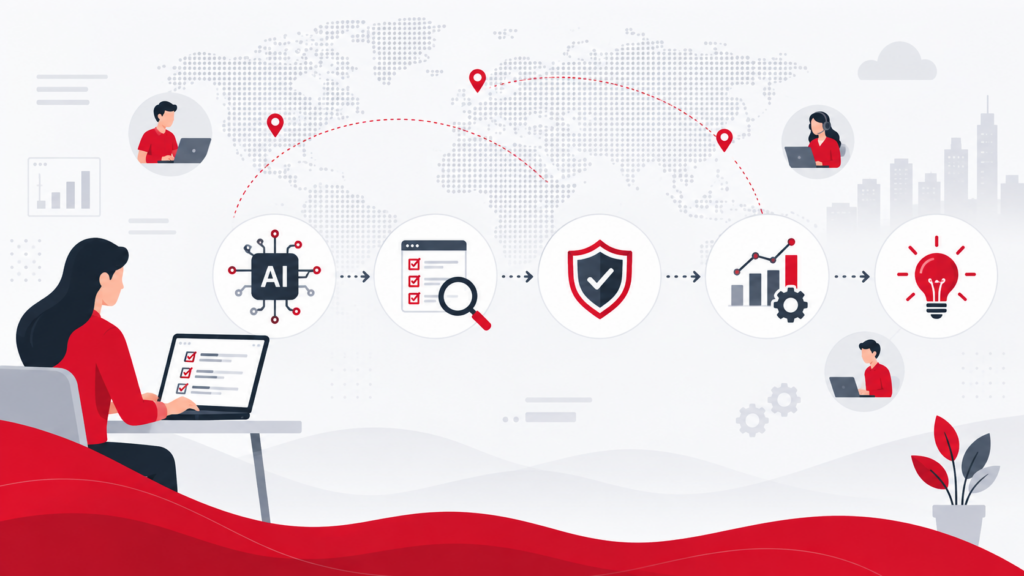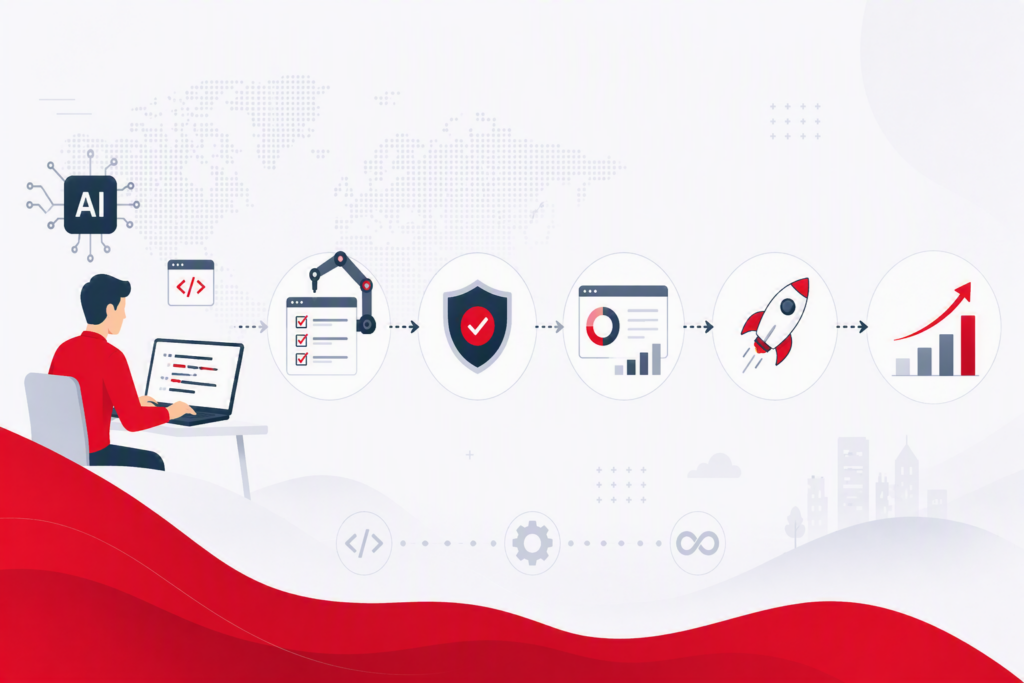

U.S. companies are expanding offshore QA, but adding offshore capacity does not automatically create a global QA organization. The challenge is creating one governance model across onshore and offshore teams. Effective global QA models centralize governance, playbooks, and automated reporting, distribute execution regionally, use follow-the-sun staffing for coverage instead of increasing headcount, and require AI-generated code and AI-assisted testing to pass the same quality gates as human-written work.
The outsourced software testing services market is expected to grow from $70.42 billion in 2026 to $122.36 billion by 2030, representing a 14.8% compound annual growth rate.*1 As this market grows, however, scaling offshore capacity also increases the need for effective governance. According to Gartner’s 2026 CIO Agenda, CIOs who proactively address geopolitical and vendor complexity are 51% more likely to outperform, yet only 28% prioritize this.*2 This article addresses the gap between rapid global QA expansion and the lack of effective governance.
For CTOs managing QA across a U.S. headquarters and offshore teams, the key issue is not whether to distribute testing, as distribution is already common. The real question is whether teams operate under a shared governance model or separate, independent processes. This distinction impacts release quality, audit results, incident reviews, and onboarding speed for new markets.
1. Elements of a Global QA Strategy: Governance, Playbooks, and Tooling
A global QA strategy relies on three essential components. Omitting any of them can lead to fragmented decision-making, inconsistent testing practices, and increased production risk as global QA operations scale.
- Governance: a documented decision structure that defines who owns test strategy, who can approve a release, and how disputes between onshore and offshore teams get resolved without escalating to the CTO every time.
- Playbooks: written, versioned standards for test case design, defect severity classification, environment setup, and regression scope, ensuring consistent application across all locations without requiring real-time coordination.
- Tooling: a shared test management system, a unified automation framework, and a single source of truth for defect status, ensuring all teams have access to consistent quality metrics.
The part teams miss in 2026 is that governance and playbooks now must explicitly cover AI-assisted work. When a developer uses a coding assistant to generate a pull request, or a tester uses an AI tool to draft test cases, that output needs to enter the same review and defect-tracking pipeline as anything else. A QA governance model that treats AI-generated code as a special case, reviewed less rigorously because it “came from a tool,” can create gaps in the review process.
Another trend is declining developer trust in AI-generated code, which fell to 29% in 2025 from 40% the previous year, despite increased adoption.*3 As AI-assisted code volume grows, effective QA governance must ensure increased human verification.
2. Knowledge Transfer and Documentation Standards for Offshore Teams
Knowledge transfer (KT) is a common failure point in global QA programs. Often, KT occurs informally during onboarding and is not maintained, resulting in offshore teams working with outdated product knowledge within months.
A sustainable KT process includes several key elements. Test documentation should reside in the same repository as the code, versioned together to prevent misalignment. Domain knowledge, business rules, and edge cases must be maintained as ongoing test artifacts, not as one-time training materials. KT should occur on a recurring basis, using a standardized documentation template for each handoff, ensuring consistency regardless of who conducts the transfer.
AI tools can assist by generating draft documentation from code comments or summarizing pull requests, saving time on routine tasks. However, a domain expert must still verify documentation accuracy before offshore teams begin testing. Skipping this verification leads to simultaneous debugging of documentation and product defects, increasing both time and cost.
3. Regional Specialization vs Centralized Services: Where to Put Which Tests
Not all test types should be located in the same region. Assigning tests based on convenience rather than strategic design often results in coverage gaps.
Centralization is appropriate for work that benefits from a single source of truth, such as core automation frameworks, security and compliance testing standards, and test suites validating shared product behavior. Regional specialization is best for inherently local tasks, including localization, language testing, region-specific payment and tax logic, and compliance testing tied to specific jurisdictions.
That second category has gotten more complicated. Data sovereignty requirements are now a factor in deciding where test data can even live, not just where testers sit. Gartner’s 2026 CIO Agenda specifically calls out a shift among CIOs from globally agnostic sourcing to geo-strategically aligned sourcing, driven by data sovereignty laws and vendor geographic concentration risk.*2 For a CTO with users in the EU, that can mean test environments and test data for certain features must physically remain within the region, which affects where testing can be centralized versus where it must run locally, regardless of where the rest of the QA program lives.
A practical guideline is to centralize tasks where consistency is more important than local context, and regionalize those where local context is essential.
4. Staffing Models and Time Zone Design for Follow-the-Sun Testing
Follow-the-sun testing is effective only when focused on high-quality handoffs, not merely on staffing every time zone. Without a defined handoff protocol, distributed teams operate in isolation rather than providing true 24-hour coverage.
Effective staffing models include a documented handoff format for each shift change, detailing completed tests, failures, blockers, and next priorities. They use a unified test management system with real-time status and provide an overlap window for direct communication between outgoing and incoming teams.
AI agents now extend coverage between shifts by running scheduled regression suites or triaging defects overnight, allowing the next region to begin with a prioritized queue. While this improves efficiency, it changes the handoff process rather than removing it. The handoff protocol must explicitly document automated activities, including what the AI agent executed, flagged, and what still requires human review.
5. Quality Gates and Release Criteria Across Geographies
A quality gate is effective only if its criteria are consistent across all regions. If one team requires a 90% regression pass rate and another ships at 75% due to misaligned gates, the release criteria are not truly shared.
Consistent release criteria require uniform defect severity classification, explicit sign-off authority for releases with open defects and defined severity thresholds, and standardized reporting metrics across all regions, including defect escape rate, regression coverage, automation pass rate, and time to triage.
AI-generated or AI-assisted code and test artifacts require a formal review process before being considered release-ready. With developer trust in AI-generated code at 29%*3, allowing AI-assisted work to bypass standard gates introduces unnecessary risk.
6. Centralized Automation Governance and Dashboards in Global Oversight
Centralized automation governance establishes shared automation frameworks, coding standards, and reusable test libraries across regions. Its purpose is to ensure that regression suites function consistently across locations and to prevent the development of parallel, incompatible frameworks.
A unified dashboard enables effective global oversight by consolidating test execution data from all regions. This provides CTOs with a comprehensive view of automation coverage, defect trends by geography, and release readiness. In 2026, dashboards should also track the proportion of AI-assisted test creation and code review, along with their respective pass and defect rates. Without this visibility, CTOs cannot accurately report on the extent of human versus AI verification, a question increasingly common in board and audit discussions.
7. What This Model Looks Like in Practice: SHIFT USA × SHIFT ASIA
In practice, SHIFT USA and SHIFT ASIA can support this model by connecting U.S.-side governance with offshore QA execution in Vietnam. SHIFT USA works alongside U.S. product and QA leaders on strategy, stakeholder alignment, and quality governance, while SHIFT ASIA provides scalable test execution, automation development, and defect triage. Both sides operate through shared playbooks, quality standards, and reporting.
Shared automation frameworks and standards support both groups by maintaining consistency across U.S.-side governance and offshore execution. In addition, a dedicated role reviews and validates AI-assisted test creation and AI-generated code, ensuring these outputs are not solely managed by offshore execution or automated tools.
This model separates decision-making authority from execution responsibilities. U.S.-side product and QA leaders retain business context and release authority, while SHIFT ASIA focuses on scalable execution under shared quality standards. SHIFT USA helps maintain alignment between the two, reducing the risk that offshore delivery becomes disconnected from business priorities.
Challenges
A frequent failure point in global QA programs is not a lack of skills, but insufficient verification. Teams increase output with AI assistance, but review capacity does not keep pace. This gap is not reflected in sprint velocity metrics but becomes evident in higher defect escape rates over time.
Another recurring challenge is documentation decay. Playbooks and KT materials are typically robust at launch but deteriorate over time due to the absence of natural update triggers. Successful teams incorporate documentation updates into the definition of done for any change affecting test scope, rather than treating them as separate, lower-priority tasks.
A third challenge is metric fragmentation across regions, where teams optimize for local definitions of quality that do not aggregate into a single, actionable metric for CTOs. This often results from regionally adopted tooling, highlighting the importance of centralized automation and dashboard functions as governance mechanisms.
Governance
The governance framework consists of a documented RACI for test strategy, release approval, and defect escalation; a defined audit schedule—for example, quarterly—to review automation coverage, AI-assisted work ratios, and defect trends against the original playbook; and a clear escalation path that minimizes the need for CTO involvement in routine disputes.
Standards alignment is also critical. Mapping internal playbooks to ISTQB test process standards and ISO/IEC/IEEE 29119 provides CTOs with external benchmarks for audits and vendor evaluations. This approach ensures the governance model remains effective and portable when changing vendors, bringing testing in-house, or expanding into new regions, as the standards are embedded in the process rather than dependent on individual teams.
The Bottom Line
None of the seven elements above work in isolation. Centralized automation governance is only as effective as the playbooks and standards it enforces, and a follow-the-sun staffing model only extends coverage if the handoff documentation behind it is up to date. The organizations getting this right in 2026 treat global QA as one governed system with regional execution points, not as a home team plus a vendor bolted on to cut cost.
The AI layer raises the stakes on that choice rather than changing it. More code and more tests are being produced faster than review capacity is scaling, and developer trust in that output is falling, not rising. A global QA strategy designed primarily around manual testing across time zones is not suited to a pipeline in which a meaningful share of what ships is AI-assisted and requires a defined human checkpoint. Governance is what closes that gap. Everything else in this article is the mechanism for making governance actually operational, rather than a slide in a vendor pitch.
Global QA that withstands audit scrutiny, not just demonstration scenarios.
Onshore governance, offshore execution, unified by a single framework.
SHIFT USA helps bridge U.S. product leadership and global QA delivery, combining U.S.-side stakeholder alignment and quality governance with SHIFT ASIA’s scalable test execution and automation capabilities in Vietnam. Both teams operate through a shared quality model built on the SHIFT Quality Framework (SQF), aligning quality gates, testing standards, metrics, and reporting across onshore and offshore delivery.
If your offshore QA operation is scaling faster than your ability to govern it, SHIFT USA can help you build a global QA operating model that scales execution without fragmenting quality.
References
*1 Research and Markets, “Outsourced Software Testing Services Market Report”
*2 Gartner, “2026 CIO Agenda”
*3 Stack Overflow, “2025 Developer Survey”