Introduction
The pressure on engineering leaders has not let up. The United States entered 2025 with roughly 1.4 million unfilled technology roles against only about 400,000 annual computer science graduates, according to Mordor Intelligence. That gap is why development outsourcing has stopped being a cost play and become a capacity strategy. The global software development outsourcing market sat near 564 billion dollars in 2025 and is projected to reach 977 billion dollars by 2031, a compound annual growth rate of 9.6 percent. Offshore models still account for just over half of that spend, while nearshore is the fastest growing segment. Then AI arrived at scale and changed the rules again.
By early 2026, close to half of all new code was being generated or heavily assisted by AI, and Deloitte projects AI-driven productivity gains of 30 to 35 percent across the software lifecycle. Harvard Business Review argues this is eroding the labor-arbitrage logic that outsourcing was built on. The headline hourly rate matters less now. The ability to govern what AI produces matters more.
For a CTO, the decision is rarely “should we outsource.” It is “which model fits this product, this team, and this risk profile.” This guide breaks down both models in plain terms, shows how AI is rewriting the risks, and explains why the answer now comes down to quality discipline
Understanding Outsourcing Models: Nearshore vs Offshore
Development outsourcing is the practice of contracting software to work to an external team instead of building everything in the house. There are three common models, and the difference comes down to distance.
Onshore means working with a vendor in your own country. You get the closest cultural and time zone fit. You also pay full domestic rates, which defeats most of the financial cases.
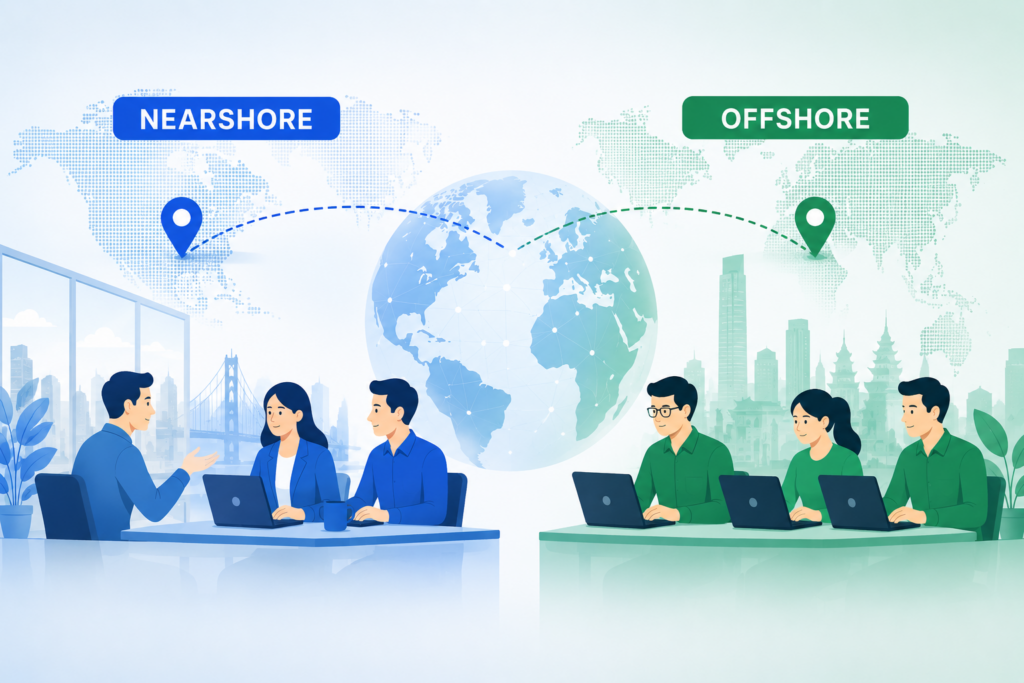
Nearshore means working with a team in a nearby country that shares a similar time zone. For North American companies, that almost always means Latin America. You keep most of the real-time collaboration of onshore work while cutting costs.
Offshore means working with a team in a distant region, typically Asia or Eastern Europe. The time zone gap is wide. The cost savings and the talent pool are the widest of any model.
These models are not mutually exclusive. Many engineering organizations run a blend: an offshore team for steady, well-defined build and test work, plus a nearshore squad for product work that needs constant back and forth. The labels matter less than the trade-offs behind them.
The Rise of Nearshore Development for North American Companies
Nearshore is the segment growing fastest, and the reason is collaboration speed. Mordor Intelligence pegs nearshore growth at roughly 14 percent annually through 2031, well above the broader market.
Three forces are driving the shift. First, software has moved toward continuous delivery, where code reviews, standups, and incident responses happen many times a day. A team that is awake when you are removing the overnight delay that slows that cadence. Second, Latin America has built real depth. The region is now home to more than 2.6 million engineers, with Brazil, Mexico, and Argentina leading, alongside strong English proficiency in hubs like Mexico, Colombia, and Uruguay. Third, cultural affinity is high. Many Latin American engineers have worked with US companies, know agile practices, and share business norms with North American teams.
The result is a model that feels close to having an in-house extension. The trade-off is that nearshore costs more than offshore, and the talent pool, while strong, is smaller than Asia’s. Nearshore is rising because for product-led companies, speed of iteration has become worth the premium.
Nearshore Software Development: Deep Dive
What it is: Hiring a development or QA team in a country one to three time zones away. For North America, this is Latin America.
Cost. Nearshore engineers in Latin America typically cost 30 to 50 percent less than comparable US hires. Senior developer rates commonly fall in the 30 to 65 dollars per hour range depending on country and seniority. You are not buying a weaker talent. You are accessing similar skills at a lower cost of living.
Time zone. This is the headline advantage. Most Latin America sits within a one to three hour offset from US business hours, which gives teams four to six hours of daily overlap or more. Bugs found in the morning get fixed the same day. A question does not wait until tomorrow for an answer.
Communication. English proficiency is strong in the major nearshore hubs, and cultural alignment reduces misread requirements. Fewer handoffs go wrong when both sides share context.
Where it fits. Nearshore is a strong match for fast-moving product teams, startups iterating toward product-market fit, and any work that depends on tight, real-time collaboration. It is also a good fit when your internal team is small and needs a partner that operates like a true extension.
The honest limit. Nearshore costs more than offshore, but AI is undercutting its core advantage. The case for nearshore now rests on the narrower set of work that genuinely needs human collaboration.
Offshore Software Development: Deep Dive
What it is: Hiring a development or QA team in a distant region, most often Asia (India, Vietnam, the Philippines) or Eastern Europe.
Cost. Offshore delivers the largest savings of any model. Hiring in Asia can cut fully loaded costs up to 70 percent against US rates. Senior developer rates in Southeast Asia commonly run 25 to 50 dollars per hour, a fraction of the 120,000 to 180,000 dollars a senior US engineer costs before benefits and overhead.
Scale and talent. The depth is unmatched. India has a developer population in the millions and handles a large share of global IT outsourcing. Vietnam has grown into one of Asia’s strongest hubs, with more than 530,000 IT professionals, around 57,000 new tech graduates a year, and rising strength in modern stacks, cloud, and AI. When you need to staff a large program quickly, offshore is where the people are.
Time zone. This used to be the trade-off. The offset between North America and Asia runs around 12 hours. AI has shrunk the cost of that gap by handling overnight coordination, summarizing progress, and keeping handoffs clean. The gap that once defined offshore is now a manageable detail for partners who use AI well.
Where it fits. Offshore shines for large, well-scoped programs, sustained engineering and maintenance, and quality work such as offshore software testing and QA outsourcing services, where structured process matters more than constant real-time chat. It is also the right call when budget and scale are the deciding factors.
The honest limit. With AI neutralizing the time zone problem, the thing that separates a good offshore partner from others is governance. A partner who runs AI agents across the lifecycle with a strong quality layer on top is powerful. A partner who bolts AI onto a weak process just produces bad code faster.
Head-to-Head Comparison
| Factor | Nearshore (Latin America) | Offshore (Asia, Eastern Europe) |
| Time zone overlap | High (4 to 6+ hours) | Low (2 to 4 hours) |
| Cost savings vs US | 30 to 50 percent | 40 to 70 percent |
| Talent pool depth | Strong and growing | Largest in the world |
| Real-time collaboration | Excellent | Requires structure |
| Cultural affinity (US) | High | Varies by partner |
| Best for | Fast iteration, product work | Scale, sustained build and QA |
| Main risk | Higher cost than offshore | Quality drift if poorly managed |
The pattern is simple. Nearshore optimizes collaboration. Offshore optimizes cost and scale. Both can deliver high quality. What separates a good engagement from a bad one is rarely the region. It is the partner process, the clarity of your scope, and how well the two teams are set up to work together.
The AI Era: Rewriting Sourcing Risks
This is the part of the conversation that has changed most, and it cuts across every other section in this guide.
Artificial intelligence, in the form of large language models and AI agents, is neutralizing the classic pain points of outsourcing. The 12-hour offshore time gap used to mean an overnight wait for every answer. AI now closes much of that gap by acting as a 24/7 automated coordinator: it summarizes overnight progress, keeps documentation current, drafts handoffs, and keeps work moving while everyone sleeps. Nearshores’ main weakness, the attrition risk of losing a key engineer who carries critical context in their head, is softened too. Automated knowledge mapping captures how a system actually works, so that knowledge no longer walks out the door with one resignation.
That sounds like good news, and it is. But AI does not eliminate risk. It shifts it. In the AI era, engineering leaders face two new threats that matter more than time zone or rate.
Velocity without verification. AI can generate code and test cases at ten times human speed. That cuts both ways. Feed it requirements that are slightly flawed, and it will produce broken code and redundant tests at unprecedented volume. Speed multiplies errors just as fast as it multiplies output. The data backs this up: roughly half of new code is now AI-assisted, yet only about a third of AI suggestions get accepted as written, and human review still decides what ships. The bottleneck has not vanished. It has moved from writing code to verifying it. Without a serious quality system, AI does not make a weak vendor good. It makes them wrong faster.
The governance trap. AI tools are only as safe as the rules around them. Without ironclad compliance and secured tooling, a remote team can leak sensitive intellectual property into unsecured public AI tools. One engineer pasting proprietary source code into a public chatbot to debug it is a real breach, and it happens quietly. For regulated industries, that is not hypothetical. It is an audit finding that is waiting for happening.
Put those two threats together, and the conclusion is clear. The AI era does not reward the closest time zone or the cheapest rate. It rewards whoever has the quality discipline and governance to control AI output. That reframes from the entire nearshore versus offshore decision, which the rest of this guide follows.
What does it mean for your outsourcing decision? When you hand AI-accelerated development to a remote or offshore vendor, you do not hand off the liability. You stay responsible for how AI tools touch your data, your code, and your customers, and for proving it if a regulator or auditor asks. That turns the governance trap into a compliance exposure. The practical defense is a partner who can show exactly how AI is secured, how intellectual property is contained, and how every output is documented and auditable. The policy direction points to the same conclusion as the rest of this guide does: in the AI era, governance is the deciding factor.
When to Choose Nearshore Development
Choose nearshore when collaboration speed is the constraint that hurts most. That is usually the case when:
- Your product is at an early stage, and requirements change weekly.
- Your team is small and needs a partner that behaves like an in-house extension.
- The work depends on daily live discussion, pairing, or rapid incident response.
- A few hours of overnight delay would genuinely slow your roadmap.
- Deep, continuous cultural alignment with your in house staff is worth a premium.
If real-time overlap is worth a moderate cost premium to you, nearshore is the safer choice. If they do not, AI has made it harder to justify paying for overlapping hours you no longer strictly need. Either way, confirm the partner governs AI output well, because proximity is no protection against velocity without verification.
When to Choose Offshore Development
Choose offshore when cost, scale, or specialized capacity is the constraint. That is usually the case when:
- The program is large and well defined, with a scope that does not shift daily.
- You need to staff up quickly, and the talent simply is not available at home.
- The work is structured and process-driven, such as sustained engineering, regression and offshore software testing, or QA outsourcing services.
- Budget efficiency is a board-level priority.
The key is the partner. Offshore with a vendor that brings strong project management, clear written communication, and a proven quality method will outperform a poorly run nearshore engagement on both cost and outcome. The time zone gap is a solvable logistics problem when the process is mature.
Success Factors for Both Models
The model you pick matters less than how you run it. Across both nearshore and offshore, the same things separate success from frustration.
Clear scope and documentation. Ambiguity is expensive at any distance and ruinous across a 12-hour gap. Write requirements down, define done, and keep a single source of truth.
Strong project management. Someone has to own coordination, surface blockers early, and protect delivery of velocity. This is the single biggest predictor of offshore success.
A defined overlap window. Even a few shared hours, used deliberately for live discussion and decisions, keeps momentum. Protect that window on both sides.
A real quality system. Velocity without quality is just faster for rework. Look for a partner with a structured testing method, not ad hoc checks. This is where offshore software testing and dedicated QA outsourcing services prove their value, because they catch defects before they reach production.
Verification that keeps pace with AI. A modern partner should use AI to accelerate work and must verify the output as rigorously as human-written code. AI raises throughput and risk at the same time. This is where offshore software testing and dedicated QA outsourcing services earn their keep, by catching AI’s confident mistakes before they reach production.
Governance, IP security, and compliance. Confirm how a partner controls AI tooling. Are engineers using secured, enterprise AI environments, or whatever public tool is handy? With US AI policy tightening on security and procurement, clear rules on what data can touch which tools, backed by auditable records, are now a basic requirement rather than a nice to have.
Communication discipline. Default to clear written updates, shared dashboards, and predictable rhythms. Good communication is a habit, not a personality trait.
Cultural and language fit. Strong English and shared working norms reduce the misunderstandings that quietly drain timelines.
Get these right and either model can deliver. Get them wrong and neither will.
SHIFT USA’s Unique Positioning
In an automated landscape, success is no longer about finding the closest time zone or the absolute cheapest rate. Most teams frame this as a binary: pay more for nearshore collaboration or save more offshore and accept the friction. SHIFT USA exists to break that trade-off.
We are the North American arm of SHIFT Inc., a company that earned its name in Japan doing one thing at a very high level: making sure software is right before it ships. Quality assurance is not a side service we bolted on. It is an entire business. Operating from the US, we take that focus and point it at the exact problem this guide is about, which is keeping quality intact when your build or test team sits in another country and another time zone. We are not asking you to pick us instead of a Latin American squad or an Asian delivery center. We are the layer that keeps either choice honestly. Run offshore software testing across a 12-hour gap.
Japanese-grade quality discipline. Japanese quality practice has a particular character: exhaustive coverage, rigorous defect classification, and a low tolerance for shipping defects that shows up directly in lower production incident rates. SHIFT built one of the largest QA-specialist workforces in Japan around exactly that discipline. In the AI era, that discipline is the thing that turns raw AI velocity into output you can actually trust. SHIFT USA brings the same methods, frameworks, and execution standards into the United States, adapted to American release cadences and regulatory realities rather than watered down to fit them.
Delivery through the Japan-Vietnam nexus. Vietnam offers a different combination: a young, hyper-agile, and increasingly AI-fluent talent pool, paired with a working culture that prizes meticulous process adherence. That disposition aligns naturally with Japanese quality standards, which is exactly why the SHIFT group built its delivery hub there, SHIFT ASIA. Pair Vietnamese execution with Japanese-grade quality discipline and you get both halves of the AI-era equation: the speed to use AI aggressively, and the governance to trust what it produces.
AI-native delivery, with quality built in. The AI shift reshaping this entire decision runs through the SHIFT group too. SHIFT ASIA, the group’s Vietnam-based development and QA arm, has built a proprietary AI-Driven Development and Testing framework: a network of AI agents that take ownership across the full lifecycle, from requirements and architecture through coding, test design, test execution, and defect resolution. What separates it from a generic coding assistant is the quality layer. SHIFT’s QA methodology, refined over two decades in Japan, is built directly into the agents, so coverage is documented, edge cases are justified, and results are auditable. The principle behind it is plain: engineered by humans, accelerated by AI. That is governed velocity, not velocity for its own sake.
Conclusion
Nearshore and offshore are not rivals. They are tools, and each is right for a different job. Nearshore buys you collaboration speed and real-time overlap, at a moderate premium. Offshore buys you cost, scale, and the deepest talent pools in the world, at the price of disciplined coordination. For most North American CTOs, the honest answer is to match the model to the work in front of you, not to pick a side once and for all.
What does not change is the deciding factor underneath both: the partner. A mature partner with strong process, clear communication, and a real quality system will outperform a weak one regardless of the map. That is the gap SHIFT USA was built to close. We bring offshore cost and scale, with the Japanese-standard quality and disciplined project management that make distance a non-issue.
If you are weighing development outsourcing, offshore software testing, or QA outsourcing services for your next program, talk to SHIFT USA. We will help you choose the model that fits and delivers it to a standard you can build on.