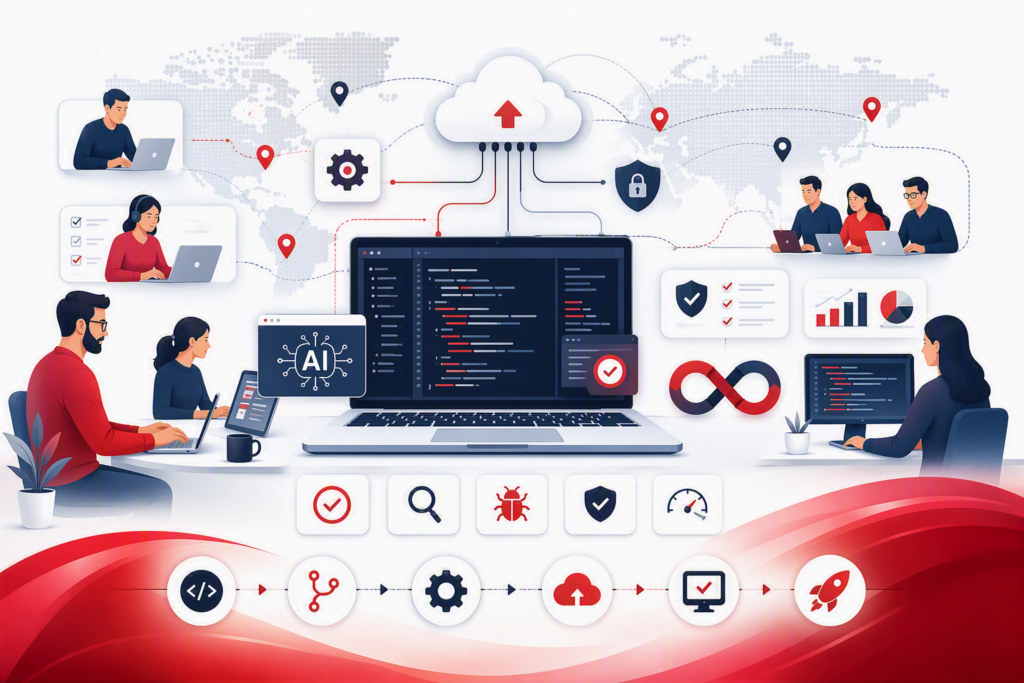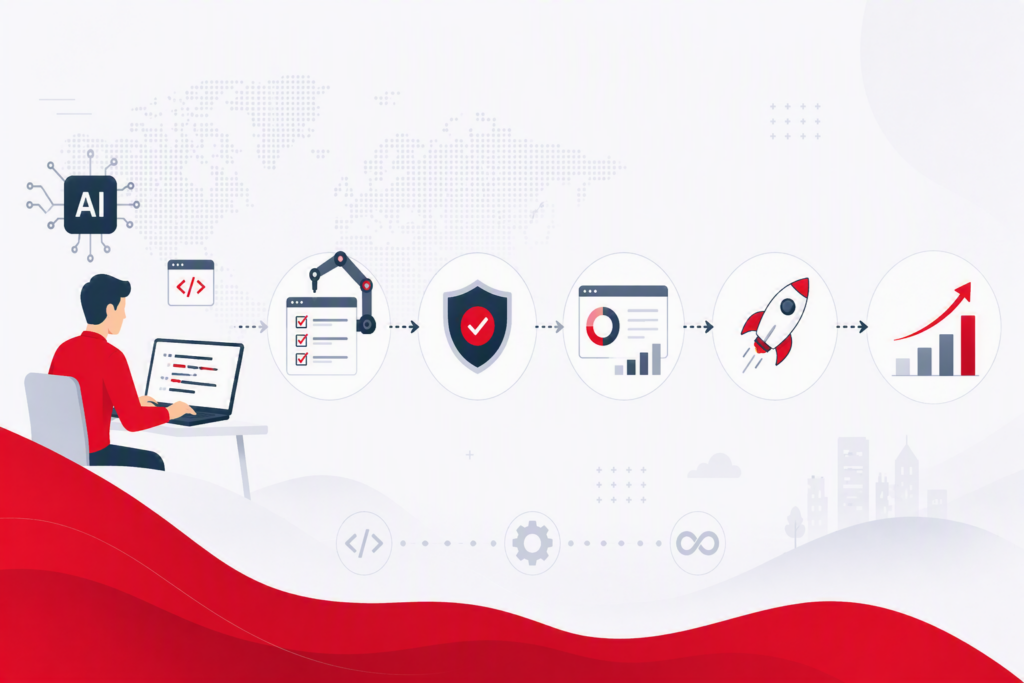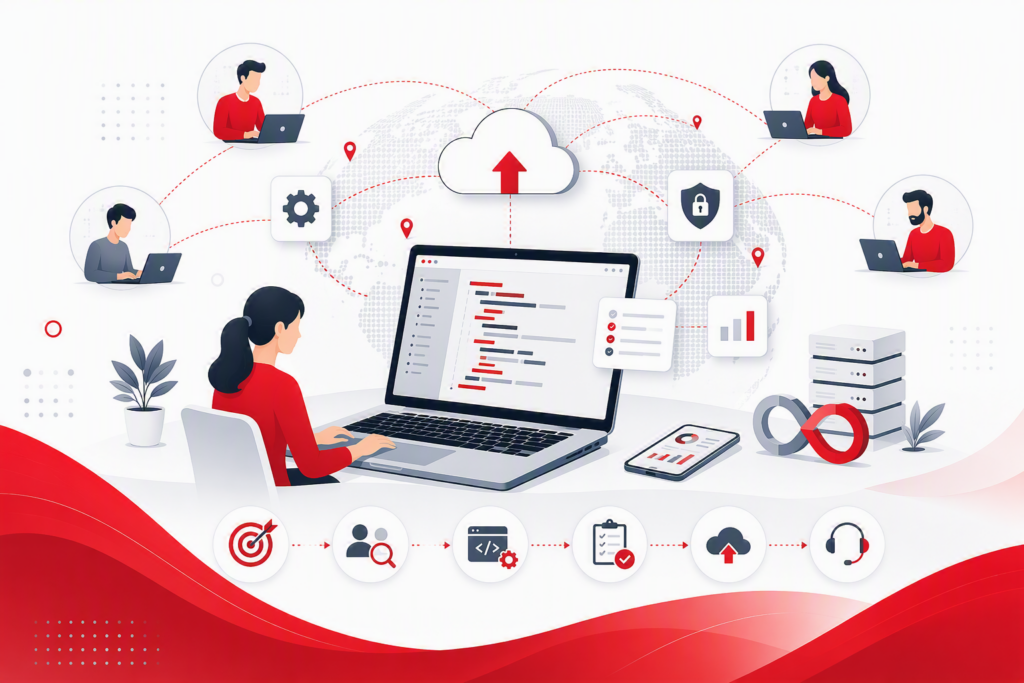
AI features are showing up in products faster than most QA teams can keep pace with. A chatbot that answers customer questions, a recommendation engine that drives revenue, a fraud model that flags transactions in real time. Each one carries a different kind of risk than a login form or a checkout flow and testing them the old way simply does not catch what matters.
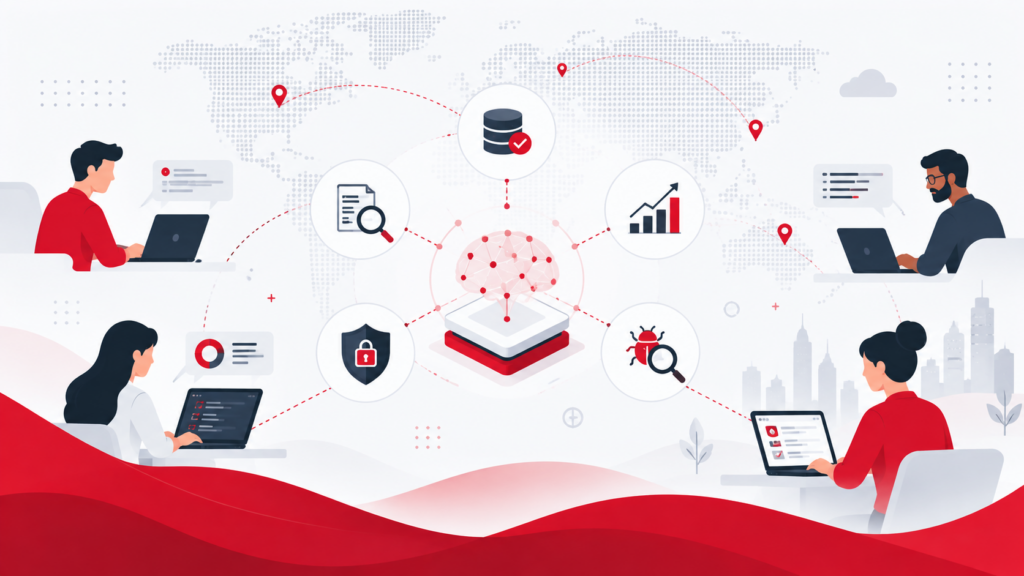
At the same time, the outsourced QA market is growing fast. The outsourced software testing market (*1) is projected to double from 39.93 billion USD in 2026 to more than 101 billion USD by 2035, at a 10.8 percent annual growth rate, driven largely by the central role both testing and AI have become in how software is built and shipped. Yet the same research shows that half of organizations still lack AI or ML expertise inside their QA function, a gap that has not moved much since 2024. That gap is exactly where offshore QA partners with dedicated AI practices step in.
This article walks through what makes AI and ML testing genuinely different, which testing approaches work, what can safely move offshore and what should stay close, and how to build governance and tool around it so speed does not come at the cost of trust.
What Makes AI/ML Testing Different
Traditional software testing checks whether a system behaves as it was coded to. Give it input A, expect output B, and if the code has not changed, the result should not change either.
AI and ML systems break that assumption in three ways.
Data quality determines correctness. A model is only as reliable as the data it was trained and evaluated on. Biased, incomplete, or mislabeled training data does not throw an error the way broken code does. It just produces a model that quietly gets things wrong, often in ways that are hard to spot until the system is already in production.
Drift means that what is correct today does not mean it is correct tomorrow. A model that performs well at launch can degrade over time as real-world data shifts away from what it was trained on. This is called data drift or model drift, and unlike a software bug, it is not something you fix once and close out. It must be monitored continuously for as long as the model is alive.
Explainability is part of correctness, not an afterthought. For a model making a lending decision, a medical triage suggestion, or a content moderation call, “the model said so” is not good enough. Testers increasingly need to verify not just what model outputs but also why, particularly for systems subject to emerging AI governance requirements.
Put together, these differences mean AI QA needs people who are comfortable with statistical validation and ML evaluation metrics, not only functional test scripts against a UI.
Testing Approaches for AI and ML Systems
A mature AI QA program usually layers several testing approaches rather than relying on one.
Data validation. Before a model is trained or retrained, the input data itself needs to be tested: checking for missing values, class imbalance, label errors, duplicate records, and demographic representation gaps that could bias downstream outcomes.
Model evaluation. This covers accuracy, precision, recall, F1 score, and other metrics appropriate to the task, benchmarked against a held-out test set the model has never seen. For generative or agentic systems, evaluation also includes checking outputs for relevance, coherence, and factual grounding, sometimes with a human reviewer in the loop and sometimes with a second model acting as judge.
Adversarial testing. This is the practice of deliberately trying to break a model by feeding it edge cases, ambiguous inputs, or inputs crafted specifically to trigger an incorrect or unsafe response. For systems exposed to the public internet, this also covers prompt injections and jailbreak attempts, which have become standard items on any responsible AI test plan.
Monitoring in production. Testing does not stop at release. Production monitoring tracks live model performance, flags drift, logs anomalous outputs, and triggers retraining or human review when metrics fall outside acceptable ranges. The NIST AI Risk Management Framework treats this kind of continuous measurement as a core function, not a one-time checkbox.
The Offshore Model for AI QA: What to Outsource and What to Keep Close
Not every part of AI testing belongs in the same place. A workable offshore model draws a clear line between work that scales well remotely and work that carries too much risk to leave the building.
Well suited to offshore teams:
- Data labeling and annotation at volume, since this is exactly the kind of large-scale, repeatable work that benefits from a distributed team working around the clock
- Building and maintaining test harnesses, synthetic test datasets, and evaluation pipelines
- Running adversarial and edge case test suits a model’s public-facing behavior
- Regression testing after each model update or retraining cycle
- Bias and fairness evaluation using de-identified or synthetic data
Better kept close to the source:
- Access to raw production data containing personal or regulated information
- Final sign-off on model behavior for high-stakes use cases such as healthcare, finance, or hiring decisions
- Proprietary training data or model weights where IP protection is a priority
- Decisions about acceptable risk thresholds, which usually suit product or compliance leadership
The dividing line is not offshore versus onshore as a matter of trust. It is about matching the sensitivity of the data and the decision to the appropriate level of access and oversight, wherever the team is physically located.
Governance: Privacy, Explainability, and Audit Trails
Governance is what turns “we tested it” into “we can prove we tested it,” and that proof matters more with every passing quarter as AI regulation catches up with AI adoption.
Privacy starts with data minimization: offshore QA teams should work with de-identified, synthetic, or subsetted data wherever possible, so a testing environment never becomes a second copy of sensitive production data. Explainability requirements mean test plans should record not just pass or fail results but the reasoning behind a model’s output, especially for regulated use cases. And audit trails, meaning detailed, timestamped logging of what was tested, by whom, against which model version, and with what result, are what let a company demonstrate compliance after the fact rather than reconstructing it from memory.
The NIST AI Risk Management Framework (*2) organizes this work into four functions: Govern, Map, Measure, and Manage. Govern sets policy and accountability, Map documents where risks live in each system, Measure evaluates the model and its controls, and Manage handles ongoing monitoring, drift response, and incident escalation. Offshore QA partners that structure their testing around a framework like this give clients something concrete to point to during an audit or a customer security review, rather than a vague assurance that testing happened.
Automation and Tooling for AI QA
Manual review alone cannot keep pace with how often models get retrained or how many inputs a production system sees in a day. Automation fills that gap in a few specific ways.
ML pipelines can run automated evaluation on every new model version before it reaches production, comparing performance against a baseline and blocking a release if key metrics regress. Curated test datasets, including adversarial sets and edge cases collected from real production incidents, are reused across every evaluation cycle, so testing coverage compounds over time rather than starting from zero each time. Drift detection tooling monitors live traffic and statistical properties of incoming data, flagging when the production environment has diverged sufficiently from training conditions to warrant closer inspection. And logging and observability tooling, sometimes bundled into what teams call a compliance or audit trail (CAT) layer, ties every test run and every production alert back to a specific model version and dataset, which is what makes the governance work in the previous section auditable.
None of this replaces human judgment. It just means humans are reviewing flagged exceptions rather than manually checking everything, which is the only way AI QA scales.
A Hypothetical Offshore AI Testing Workflow
Picture a mid-sized fintech company rolling out a new AI-based fraud detection model. Here is roughly how the work might split between an onshore product team and an offshore QA partner.
The onshore team defines acceptable false-positive and false-negative rates for the business, sets risk thresholds, and controls access to the real transaction database. The offshore QA team receives a synthetic dataset modeled on real transaction patterns but stripped of any personally identifiable information and then builds a test harness that covers standard cases, edge cases, and adversarial inputs designed to probe for bias against particular transaction types or customer segments. As the model moves through several training iterations, the offshore team runs the same evaluation suite against each version, logging results in a shared dashboard the onshore team can review at any time. Once the model reaches production, the offshore team monitors dashboards for drift signals and flags anomalies within an agreed response window, while final decisions about retraining or rollback stay with the onshore team.
The result is a QA process that runs nearly around the clock and scales with the volume of testing an AI system demands, while the most sensitive data and the highest-stakes decisions never leave the client’s direct control.
Risks and How to Mitigate Them
Data leakage. The biggest concern clients raise about offshore AI testing is sensitive data ending up somewhere it should not. This is a real risk, and per the Capgemini World Quality Report (*3), 67 percent of organizations cite data privacy as a barrier to scaling AI testing at all. Mitigation starts with never sending raw production data offshore in the first place, using synthetic or de-identified datasets, enforcing strict access controls and data residency agreements, and building audit logging into the workflow from day one rather than bolting it on later.
Bias. A model can pass every functional test and still produce systematically unfair outcomes for a subgroup of users. Mitigating this requires deliberate fairness testing across demographic and behavioral segments, not just aggregate accuracy metrics, and it needs to happen at every retraining cycle since a model’s bias profile can shift as its training data changes.
Model drift is going unnoticed. Without active production monitoring, a model can degrade silently for weeks before anyone notices the accuracy has slipped. The mitigation is straightforward in principle, even if it takes discipline in practice: automated drift detection with clear alert thresholds and an owner accountable for responding when an alert fires.
Communication gaps in technical detail. Explaining model architecture, evaluation metrics, and edge case findings across a distributed team requires more structured communication than a typical bug report. Shared dashboards, documented evaluation criteria, and regular syncs between onshore and offshore leads close that gap.
None of these risks is a reason to avoid offshore AI testing. They are reasons to be specific about scope, data handling, and governance before the engagement starts, which is exactly what a mature AI QA partner should walk through with a client up front.
The Bottom Line
AI systems need a different kind of testing than the software that came before them, and most in-house QA teams are still building that capability. Offshore partners with dedicated AI and ML testing practices can close that gap quickly, provided the engagement is structured around a clear line between what moves offshore and what stays close, backed by real governance rather than a checkbox.
SHIFT USA works with engineering and product teams to build AI QA programs that combine offshore execution with the data controls and audit trails required by regulated and high-stakes AI systems. If your team is shipping AI features faster than your QA process can validate them, that gap is worth closing before it reaches production.
##References
1.ThinkSys, “QA Trends Report 2026: Key QA & AI Testing Shifts and Market Insights”
https://thinksys.com/qa-testing/qa-trends-report-2026/
2.National Institute of Standards and Technology (NIST), “AI Risk Management Framework”
https://www.nist.gov/itl/ai-risk-management-framework
3.Capgemini, “World Quality Report 2025: AI Adoption Surges in Quality Engineering, but Enterprise-Level Scaling Remains Elusive”
https://www.capgemini.com/news/press-releases/world-quality-report-2025-ai-adoption-surges-in-quality-engineering-but-enterprise-level-scaling-remains-elusive/