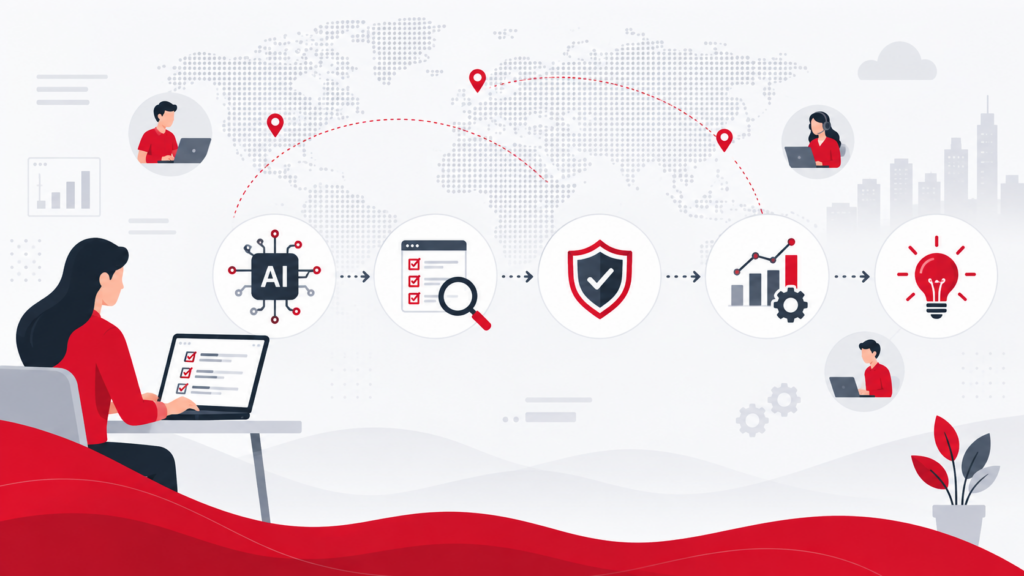
Somewhere along the way, software testing stopped being an afterthought. Release cycles that used to run quarterly now run weekly, daily and the things that need checking have multiplied: cloud services, mobile apps, embedded systems, and etc. Mordor Intelligence puts the global software testing market at USD 54.44 billion in 2026, on track to nearly double by 2031. That kind of growth doesn’t happen because testing got trendy.
So for most engineering leaders, the real question isn’t whether to bring in outside QA help. It’s how to do it without creating a mess. This guide covers what testing outsourcing actually involves, why companies go this route, where these engagements tend to fall apart, what to look for in a partner.
What Is Software Testing Outsourcing?
At its simplest, software testing outsourcing means handing some or all of your quality assurance work to an outside team. That’s the easy part. The part that actually matters is how much you hand over, because the arrangements aren’t interchangeable and choosing the wrong one is its own kind of failure.
If you just need more hands and you already know what good looks like, that’s staff augmentation; the vendor supplies testers, you still run everything. It’s low-risk and low-leverage. You’re not really outsourcing QA; you’re renting headcount, and you’re still the bottleneck.
If you want someone actually to own an outcome, a tested release, a maintained automation suite, a performance number you can trust, that’s managed testing services. The vendor owns the process and the team and commits to service levels. You keep the product; they keep the responsibility for testing it properly. This is what most people mean when they say “outsource QA,” and it’s where the real benefits live.
Then there’s Testing as a Service, the consumption model, tap a provider’s platform and talent pool, pay for what you use. Coherent Market Insights expects it to be the largest slice of the testing services market in 2026, and the logic is sound: it flexes cleanly and it suits how Agile and DevOps teams actually operate. And for regulated work, government programs, or anything where “the people who built it also checked it” won’t survive an audit, there’s independent verification and validation, a third party deliberately walled off from the development team.
Which one fits isn’t a preference question. It’s a function of how mature your internal QA already is, how much the software actually matters if it breaks, and what you’re trying to accomplish. A pre-IPO fintech cleaning up its QA practice before diligence needs something different from an enterprise just trying to unclog a release pipeline. Pick the model for the situation, not the one the vendor is best at selling.
Why Companies Outsource Testing
For a long time, outsourcing QA was a cost conversation. It still saves money, but if that’s the only reason the companies are doing it. The stronger case today is about getting capabilities you can’t easily build, moving faster, and sharing risk with someone equipped to carry it.
Getting expertise you can’t easily hire
Modern software needs testing skills that are genuinely hard to assemble in-house: finding the bottleneck in a distributed system, testing like an actual attacker would, and standing up automation that doesn’t shatter the first time someone moves a button. Global Growth Insights found that around 71% of U.S. technology companies already outsource at least part of their testing, and roughly 65% lean on outside partners specifically for automation and CI work. That’s not a coincidence, it’s a structural problem. Deep QA talent is hard to find, and harder to keep, at a company whose actual business is something else entirely.
Shipping faster
When QA is the bottleneck, every other engineering investment starts to underperform. A partner with solid automation and teams working across time zones can turn a multi-day regression cycle into an overnight one. For anyone doing continuous deployment, that’s the gap between shipping on a schedule and shipping whenever you happen to have the bandwidth.
Predictable cost, flexible capacity
Building the equivalent QA function in-house means recruiting, training, tooling licenses, environment infrastructure, and then carrying all of it even during the quiet stretches between releases. Outsourcing turns a big chunk of that fixed cost into spend that moves with demand. The savings matter, but honestly, the bigger win is being able to surge for a major launch without permanently growing your headcount to do it.
A genuinely outside opinion
Here’s something internal QA teams can’t fully fix about themselves: they share assumptions with the developers whose work they’re checking. An outside team doesn’t carry that baggage. They read the requirements differently, they question different edge cases, they think about users differently. For regulated products, or any release where getting it wrong would be expensive in public, that independence is a quality control all on its own.
Tooling without the capital outlay
Good QA vendors already carry the licenses, environments, and tooling, automation platforms, performance infrastructure, security scanners, AI-assisted test generation, that would be a serious capital investment for any one company to stand up alone. Outsourcing is, in part, just renting access to a stack that specialists maintain full-time.
Sharing the risk
A well-built outsourcing agreement moves some of your release risk, through SLAs, defect-leakage commitments, contractual quality thresholds, onto a partner whose business depends on hitting those numbers. The risk doesn’t vanish. But it’s now shared with an organization built specifically to manage it.
Common Risks and How to Mitigate Them
None of this comes for free. Outsourced QA fails in a small number of predictable ways. None of them is mysterious. All of them are preventable, but only if you build engagement by expecting them rather than discovering them.
Communication and time-zone friction
What goes wrong: Mismatched hours, language ambiguity, and handoffs that happen while one side is asleep. Defect resolution drags. Requirements blur. Trust between your developers and the vendor’s testers slowly erodes.
What helps: Pin down a real communication rhythm: daily standups, weekly defect reviews, a clear escalation path, and put everyone on the same toolchain so the vendor sees the same defect tracker and the same CI pipeline you do. Insist on at least one bilingual project manager or technical lead who can smooth over the cultural and linguistic gaps. And do not compromise on overlapping working hours. A few hours of shared daytime is where problems get caught early instead of expensively.
Inconsistent quality and process
What goes wrong: The vendor’s team works from a different definition of “done,” applies test design unevenly, or quietly slips into checkbox execution instead of actually thinking about risk. The testing looks thorough on paper and misses the things that matter.
What helps: Anchor the engagement to recognized frameworks: ISO/IEC 25010 for product quality, ISTQB-aligned test design, a defined defect classification scheme, and make the vendor demonstrate they follow them, not just say so. Require test plans, traceability matrices, and exit reports as normal deliverables. During onboarding, actually pull a sample of their test artifacts and look at them.
Data security and IP exposure
What goes wrong: Testing means giving an outside team access to your source code, production-like data, and architecture. Without real controls, that access turns into a security and compliance liability.
What helps: Require ISO 27001 certification or its equivalent, plus demonstrated alignment with whatever applies to your industry: SOC 2, HIPAA, PCI DSS, GDPR. Write data handling, access provisioning, and offboarding into the contract. Use synthetic or anonymized test data wherever you can, and treat vendor access to production environments with the same discipline you’d apply to your own staff.
Losing context and domain knowledge
What goes wrong: Vendor turnover or rushed onboarding leaves you paying for testers who don’t really understand the product they’re testing. Defects get filed in ways that annoy your developers. Risk assessments miss what actually matters to the business.
What helps: Build the engagement around a stable core team with retention commitments. Take onboarding seriously, and that means business context, not just a technical walkthrough. Make the vendor keep living documentation: runbooks, test heuristics, a domain glossary. Something that survives one person rotating off.
Hidden costs and scope creep
What goes wrong: An engagement that looked cheap on signing day gets expensive through change orders, environment costs, and rework when defects leak into production.
What helps: Negotiate clear scope boundaries and a real change-control process up front. Where you can, tie pricing to quality, defect leakage thresholds linked to fees, for instance. And insist on transparent reporting of effort, coverage, and defect metrics, so “value delivered” is something you can actually see rather than something the vendor asserts.
Incentives that don’t line up
What goes wrong: A vendor paid by the hour, the test case, or the headcount has every reason to grow the scope, and no particular reason to find your bugs efficiently. Your interest runs the other way.
What helps: Push pricing toward outcome-based models where you can, defect detection rates, automation coverage, and release readiness, so the vendor makes money by doing the thing you actually want. If pure outcome-based pricing isn’t realistic, at least build SLAs that reward finding defects efficiently rather than just logging activity.
How to Choose the Right Software Testing Outsource Partner
The market is crowded, and most vendors pitch the same way. Big system integrators, pure-play QA shops, regional offshore providers, boutique consultancies, they all show up with similar slides. This is the general checklist for separating the ones who’ll actually deliver from the ones who only present well. Think of this as the general checklist, the one you’d apply to anyone, including us.
Technical and domain depth
A real partner can demonstrate genuine capability across functional, automation, performance, security, and, increasingly, AI system testing, and ideally has worked in your industry. Ask for case studies that align with your stack and domain. Then call the references and ask how the vendor handled a hard defect, not a routine one. A vendor whose portfolio is all marketing websites is not going to credibly validate a payments platform.
Quality frameworks and methodology
Look for explicit alignment with international standards: ISO/IEC 25010, ISTQB-aligned practice, and a documented methodology that explains how they actually approach test strategy, risk analysis, automation, and defect management. You want to see that methodology in the proposal. If it only materializes after you’ve signed, that tells you something.
Communication and cultural fit
These engagements live or die on communication. Look hard at the vendor’s project management discipline, how senior the engagement lead is, what languages the team works in, and how much their day overlaps with yours. And pay attention to cultural fit, how they handle disagreement, escalation, and bad news. That matters just as much as the technical résumé, and it’s harder to fix later.
Security, compliance, and data governance
Verify certifications, such as ISO 27001 at a minimum, plus SOC 2, HIPAA, and GDPR readiness, as your situation demands. Look at how they actually handle data and provision access, and confirm the security posture is something they operate, not something they aspire to. If you’re in a regulated industry, get audit rights in writing.
Delivery model and scalability
Understand where the work happens, who does it, and how the team flexes up and down. A vendor with one delivery center carries concentration risk; one spread across geographies is more resilient but needs tighter coordination. And look at how they recruit, train, and retain QA engineers, because the team you meet during the pitch is rarely the exact team doing the work a year in.
Pricing structure
Favor pricing that lines the vendor’s incentives up with your quality outcomes: outcome-based, milestone-linked, or hybrid arrangements over straight time-and-materials. And whatever the model, transparent reporting on effort, coverage, and defects is the thing that keeps it honest.
References and track record
Logo slides don’t tell you much. Ask for clients with engagements as complex as yours, and actually contact them. The useful questions aren’t “are you happy”, they’re “what surprised you,” “how did they handle a bad release,” and “knowing what you know now, would you pick them again.”
SHIFT USA’s Approach to Software Testing Outsourcing
Everything above is the general guide, the criteria any serious QA partner should be able to meet. This section is the other question: of all the partners who can meet those criteria, why SHIFT USA?
SHIFT USA is the U.S. arm of SHIFT Inc., one of Japan’s largest software quality assurance specialists. We’re based in Palo Alto, and we exist for a specific reason: to bring Japanese-grade quality discipline to the North American market. Here’s what that actually means in practice, not as a tagline.
Japan-quality QA, delivered here in the U.S.
Japanese software quality practice has a particular character, exhaustive coverage, rigorous defect classification, and a cultural intolerance for shipping defects that shows up directly in lower production incident rates. SHIFT Inc. built one of the largest QA-specialist workforces in Japan around exactly that discipline. SHIFT USA brings the same methodologies, frameworks, and execution standards into the U.S., adapting to American release cadences and regulatory realities without being watered down to get there.
Bilingual, cross-border project management
If your business runs between Japan and North America, a Japanese company launching in the U.S., an American firm entering Japan, or a global organization coordinating engineering teams across both, we offer something genuinely uncommon: project management led by Japanese-speaking professionals who are also fluent in U.S. business practice. The communication friction that quietly sinks a lot of cross-border QA work isn’t something we patch over after the fact. It’s designed out from the start.
Backed by the SHIFT Group network
We don’t operate in isolation. SHIFT USA works alongside SHIFT Group Partners — including EAI Technologies, a Virginia-based agile development firm with deep roots in supply chain, telecom, finance, and security, and SYSCOM Global Solutions, a New York-headquartered IT services provider with a long history supporting Japanese enterprises operating in the U.S. When a QA engagement needs development, infrastructure, or integration capability sitting next to it, that network is already there.
Quality strategy, not just test execution
Our leadership pairs deep QA expertise, including executive QA experts with three decades of testing leadership at major technology firms, with senior cross-border business development experience. Practically, that means an engagement doesn’t have to stop at running test cases. It can extend into strategic quality work: designing QA programs built to survive scale, assessing QA organizations during M&A diligence, supporting localization QA for products moving between the U.S. and Japanese markets.
If what you want is a QA partner rather than a QA vendor, someone who brings Japan-grade discipline, a real U.S. presence, genuine cross-border fluency, and strategic depth — that’s the combination SHIFT USA is built to offer. And it’s not one you’ll find duplicated easily elsewhere in the market.
Let’s talk about your software testing program. Whether you’re evaluating an outsourcing partner for the first time, consolidating a QA function that grew up piecemeal, or figuring out quality assurance across U.S. and Japanese markets, SHIFT USA brings Japan-grade quality discipline and cross-border expertise to the engagements that actually matter. Contact us and let’s talk through your quality program.