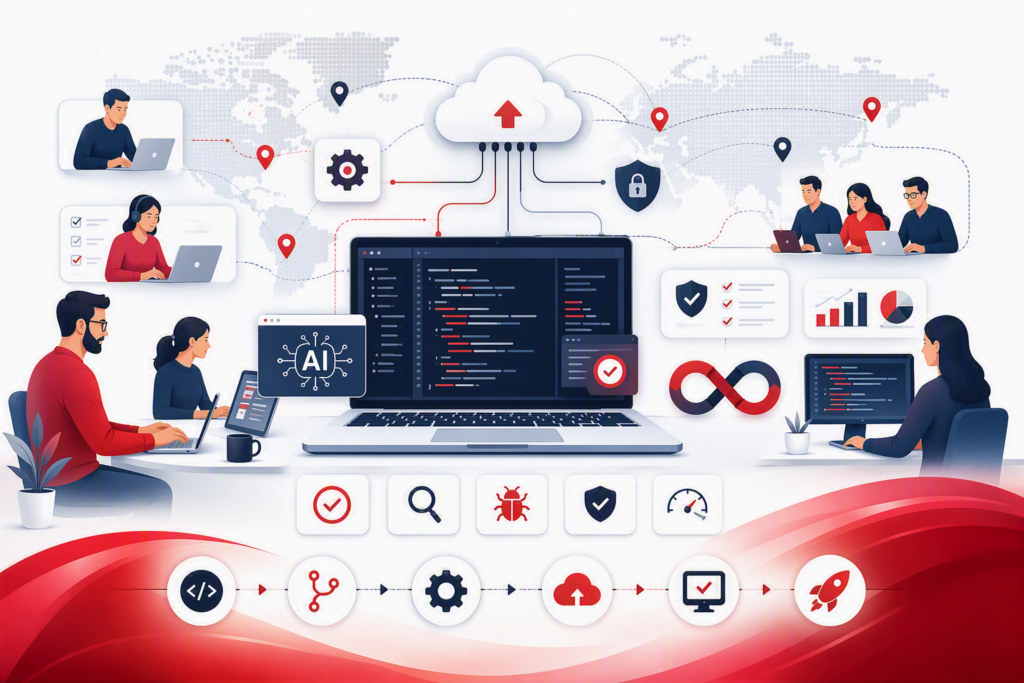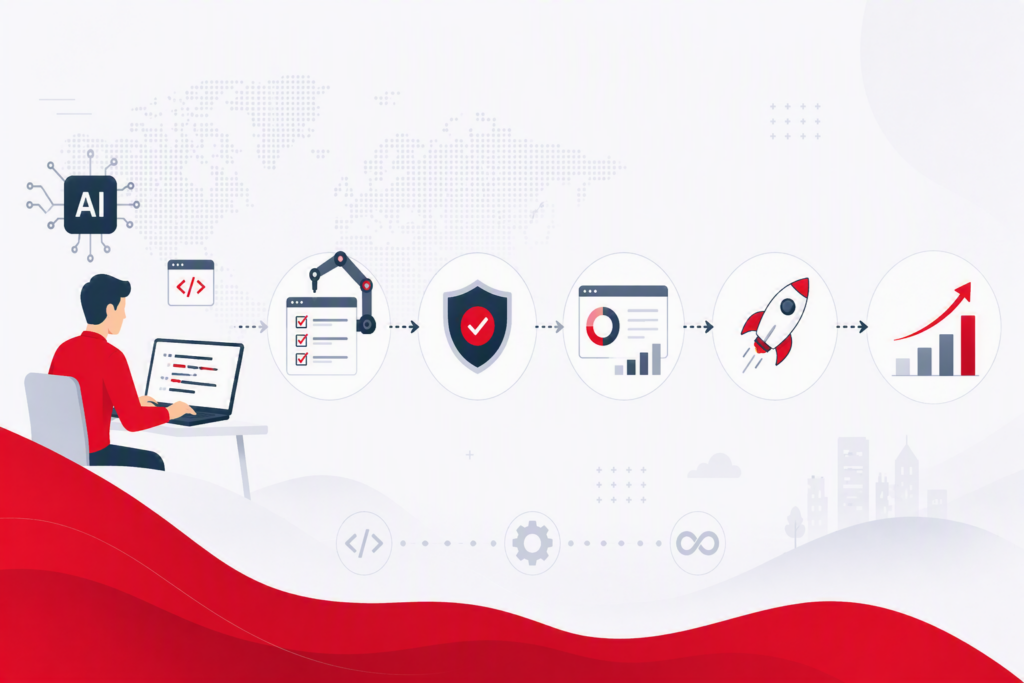
Almost every company now uses AI somewhere. Very few run it well. Stanford’s 2026 AI Index (*1) found that 88% of organizations use AI in at least one business function, while fewer than 10% have fully scaled it inside any single function. Adoption is easy. Operating a model in production, with evidence that it still works this quarter, is the hard part.
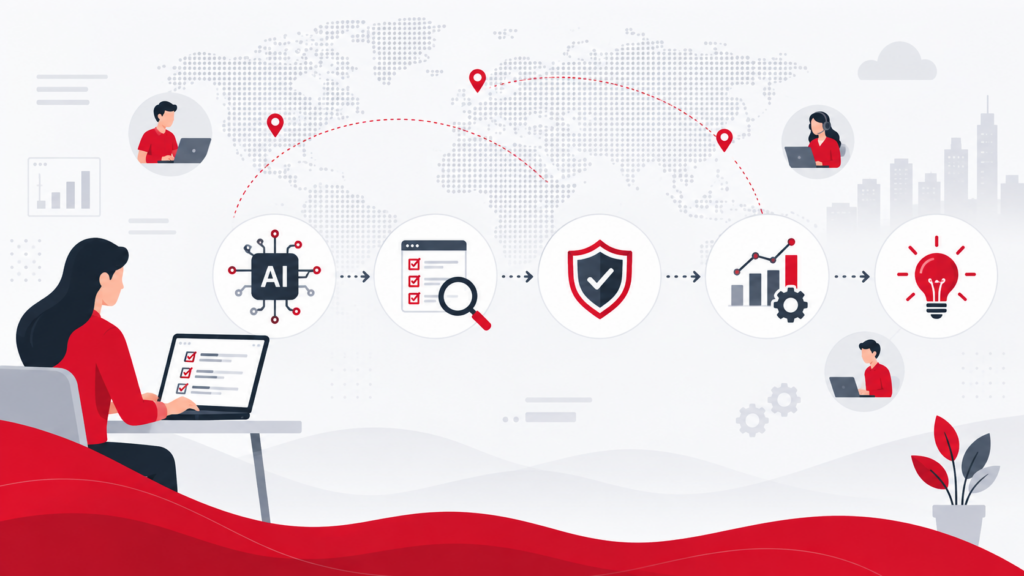
Testing sits right in the middle of that gap. Most companies already know they need to test their AI. The hard part is finding the people and hours to do it well. AI systems need more testing than traditional software, not less, and in-house teams are rarely staffed for it. A well-run offshore automation team can close that gap. It takes on the repeatable, high-volume work that AI testing demands, while your core team focuses on model design, risk decisions, and product direction.
This is where a well-run offshore automation team earns its place. Not as cheap hands for manual regression, but as the group that builds and maintains the test harnesses, data validation, and drift monitoring that make an AI system auditable. This post covers what those teams do, what should stay in-house, how to handle sensitive data, and how to measure whether the engagement is working.
What Is the Difference Between AI Testing, AI-Assisted Testing, and Test Automation?
These three terms get mixed up all the time, and the confusion leads to bad staffing and tooling decisions. So it’s worth separating them before going further.
Test automation means using scripts and frameworks to run checks without a person clicking through each step. A Selenium suite that logs in, fills a form, and checks the result is test automation. The logic is fixed. Given the same input, the software should give the same output every time.
AI-assisted testing (or “AI for testing”) means using AI tools to help testers do their jobs. Examples include generating test cases from requirements, self-healing locators in UI tests, or spotting flaky tests. Here AI is the helper, and the thing being tested might be an ordinary web app.
AI testing (or “testing AI”) means checking whether an AI or ML system itself behaves correctly, fairly, and safely. This is where the old rules break. A fraud model or a chatbot doesn’t give one correct answer. It gives probabilities, and its behavior can change when the data changes. You can’t write a single expected value and call it done.
A simple way to hold the three apart: test automation checks that software does what it was told. AI-assisted testing uses AI to check software faster. AI testing checks that a system which learns from data is still making good decisions.
The reason this matters for offshore work is that AI testing still depends heavily on test automation. You need automated pipelines to feed thousands of data samples through a model, compare results against baselines, and flag drops in accuracy or fairness. That automation layer is exactly where an offshore team adds the most value.
What actually breaks in AI systems
Data problems. Schema changes upstream, silent nulls, label noise, leakage between training and test sets, and unrepresentative sampling. Data defects are the cheapest to catch and the most expensive to miss, because they contaminate every downstream result.
Bias and fairness gaps. A model can hit strong aggregate accuracy and still fail badly for a subgroup. Aggregate metrics hide this by design, so it only surfaces with cohort level testing that someone has to build and maintain.
Model drift and decay. This is the one teams underestimate. A peer-reviewed study in Scientific Reports (*2) tested 128 model and dataset combinations across healthcare, transportation, finance, and weather, and observed temporal degradation in 91% of cases. The researchers called it “AI aging” and showed it happens even when data drift is minimal. Infrastructure dashboards stay green while predictions quietly diverge from reality.
Non-deterministic outputs. Large language models may phrase the same answer five different ways. Traditional pass or fail assertions don’t work well here. Teams need evaluation sets, scoring rubrics, and tolerance thresholds, which take time to design and even more time to maintain.
Inaccuracy in production. This is not a theoretical risk. McKinsey’s 2025 State of AI survey (*3) reports that 51 percent of respondents from organizations using AI say their organizations have seen at least one instance of a negative consequence, with nearly one-third of all respondents reporting consequences stemming from AI inaccuracy.
Look at these challenges together and a pattern shows up. Almost all of them are problems of volume and repetition, not just problems of expertise. Deciding what “fair” means for your lending model takes senior judgment. Running that fairness check against 40 customer segments on every nightly build takes disciplined automation. The second job is the one that eats your team’s calendar, and it’s the one that can move offshore.
Which tasks travel well offshore
Not everything should move. The useful split is between work that needs deep, in-the-room product context and work that is well specified and repeatable.
| Strong fit for an offshore team | Better kept close |
| Data validation suites and schema contract tests | Defining what fairness means for your product |
| Building and maintaining test harnesses and eval frameworks | Model architecture and feature decisions |
| Regression suites over golden datasets | Final release sign-off on regulated decisions |
| Cohort and slice testing across demographic or segment splits | Legal and compliance interpretation |
| Drift monitors, alert thresholds, and dashboards | Incident command during a live production failure |
| Synthetic and masked test data generation | Executive-facing risk reporting |
| CI/CD pipeline integration and maintenance | Customer-specific escalations |
| Non-functional testing: latency, cost per call, token usage |
The pattern is consistent. Offshore teams do best with engineering work that has a clear definition of done and benefits from sustained ownership. Judgment calls about acceptable risk stay with the people accountable for them.
There is also a time zone advantage worth planning for rather than tolerating. A US product team that hands off at 6pm can wake up to completed regression runs, triaged failures, and a drift report. That only works if the handoff is structured, which means written context, not a standing call at an unreasonable hour for someone.
Governance and security are the real gating factor
Most failed AI outsourcing engagements do not fail on skill. They fail because nobody solved the data access problem early enough, and the offshore team spent six weeks blocked.
Handle sensitive data by not sending it. In order of preference: synthetic data generated to match production statistical properties, masked or tokenized production extracts, then differential access to real data for a named subset of engineers only. Most AI test engineering, harness building, pipeline work, threshold tuning, does not require real PII.
Control access properly. Named accounts with least privilege, no shared credentials, VDI or a locked-down environment where data never lands on a local machine, time-bounded access that expires, and full audit logging of who queried what.
Contract for it. Data processing agreements, clear controller and processor roles, subprocessor disclosure, breach notification timelines, and a defined offboarding process for removing access when someone rolls off.
Map to a framework rather than inventing your own. NIST’s AI Risk Management Framework gives you a common vocabulary of govern, map, measure, and manage. ISO/IEC 42001 provides a certifiable AI management system standard, and ISO/IEC 27001 covers the information security baseline your vendor should already hold.
Know your regulatory dates. If you touch the EU market, the AI Act’s transparency obligations under Article 50, which cover chatbots and AI-generated content labeling, applied from 2 August 2026. The high-risk obligations under Annex III were deferred by the Digital Omnibus on AI, which entered into force on 27 July 2026, moving that deadline to 2 December 2027, with product-embedded systems under Annex I following in August 2028. Deferred is not cancelled. The evidence those obligations require, logging, data governance records, and test documentation, takes longer to build than the paperwork suggests, and an offshore automation team is a practical way to produce it continuously instead of in a panic.
Tooling and CI/CD integration
An offshore AI QA team should own a pipeline that looks roughly like this, running on every data refresh, model retrain, and application build.
1. Data validation Great Expectations or Deequ, schema and distribution checks
2. Unit and integration pytest over preprocessing, feature engineering, serving code
3. Model evaluation Held-out and golden datasets, per-cohort metrics, thresholds
4. Behavioral testing Invariance, directional, and minimum functionality tests
5. Application layer Playwright or Selenium over the user-facing AI feature
6. Non-functional Latency, throughput, cost per inference, token consumption
7. Post-deploy Drift monitoring via Evidently or NannyML, alert thresholds
Wrap it with MLflow or a comparable registry for model lineage and versioning, and DVC or equivalent for dataset versioning. Without versioned data you cannot reproduce a failure, and an unreproducible AI defect is an argument rather than a bug report.
For generative and LLM features, add an evaluation harness. Open tooling such as promptfoo or DeepEval supports rubric scoring, regression suites over prompt sets, and adversarial cases for prompt injection and jailbreak resistance. The key discipline is treating prompts as versioned artifacts that go through the same review and regression process as code.
The CI/CD rule that matters: every one of these stages should be a gate, not a report. A model that improves average accuracy but regresses on a protected cohort should fail the pipeline automatically. Offshore teams are good at building and maintaining exactly this kind of infrastructure, because it is specifiable, testable, and improves sustained ownership.
Metrics and KPIs worth tracking
Measure the engagement on outcomes, not activity. Test case counts and hours logged tell you nothing about quality.
| Category | Metric | Why it matters |
| Coverage | Percentage of models with automated evaluation gates | Shows whether coverage is real or aspirational |
| Coverage | Percentage of data pipelines with validation checks | Catches the cheapest defects earliest |
| Detection | Mean time to detect drift | The core value of the monitoring layer |
| Detection | Defects caught pre-production vs escaped to production | The classic containment ratio, applied to AI |
| Quality | Per-cohort metric spread vs aggregate | Exposes fairness gaps that averages hide |
| Quality | Evaluation suite false alarm rate | High noise means the team stops trusting alerts |
| Velocity | Model release cycle time | Good testing should shorten this, not lengthen it |
| Velocity | Percentage of retrains passing gates first time | Indicates pipeline maturity |
| Cost | Cost per inference and token spend trend | Non-functional regressions are easy to miss |
| Engagement | Percentage of handoffs needing clarification | The most honest measure of offshore collaboration health |
Set baselines in the first month. A KPI without a starting number is a talking point, not a measurement.
Checklist for starting an offshore AI testing engagement
Before you sign
1. Write down which of the three layers of AI and automation testing you are actually buying.
2. Inventory your AI systems: models in production, data sources, retraining cadence, and current test coverage.
3. Decide your data strategy: synthetic, masked, or restricted real access, and confirm it with security and legal.
4. Choose your governance frame: NIST AI RMF, ISO/IEC 42001, or your existing internal standard.
5. Confirm vendor certifications, ISO/IEC 27001 at minimum, and ask for references on AI or ML specific work rather than general QA.
6. Define the split: which decisions stay with your team, in writing.
First 90 days
7. Agree baselines for every KPI before work starts.
8. Stand up the access environment before day one so the team is not blocked.
9. Start with data validation, the fastest path to visible value.
10. Establish the daily written handoff and one weekly live overlap.
11. Ship the first CI gate inside six weeks, even if it covers one model.
12. Run a formal review at day 90 against the baselines, and adjust scope from evidence rather than impressions.
Conclusion: Faster AI Testing Starts With the Right Division of Work
AI testing isn’t a one-time gate before launch. Data shifts, models age, and every retrain can quietly undo last month’s progress. That’s why so many companies are stuck between pilot and scale. They know what good AI quality looks like, but they don’t have the hours to check it on every build.
Offshore automation solves the hours problem. When your in-house team sets the thresholds, fairness rules, and risk decisions, an offshore team can turn those decisions into pipelines that run every night. Data gets validated before it reaches training. Regression gates catch weaker models before they ship. Drift alerts arrive before customers notice anything is wrong.
The companies that get this right share a few habits. They draw a clear line between judgment and execution. They build security and governance in from the first day, not after the first audit. And they measure results against a real baseline, so the value of the engagement is visible to engineering leaders and finance alike.
Done this way, offshore AI testing isn’t about cutting corners to save money. It’s about giving your AI the steady, repeatable testing it needs to earn and keep your customers’ trust.
Ship AI You Can Trust, Without Slowing Down Your Team
References
1. Stanford HAI. “2026 AI Index Report”
2. Vela, D. et al. “Temporal quality degradation in AI models.” Scientific Reports
3. McKinsey. “The State of AI: Global Survey 2025”