
The global software testing and QA services market is projected to exceed $50.6 billion(*1) by 2026 and may reach $107 billion within the next decade, outpacing most other IT service categories. This growth is largely driven by AI coding assistants and development tools, which have accelerated code production but have not reduced the need for thorough testing. As a result, companies that previously managed QA in-house now struggle to keep up with development output. For North American companies considering outsourcing, choosing between “Asia” and “Mexico” is an oversimplification. Each region addresses different needs, and selecting the wrong one can lead to higher overall costs beyond the hourly rate.
This guide looks at the three main regions North American companies consider for QA outsourcing: Latin America, Eastern Europe, and Asia-Pacific. We cover real costs, the value each region offers, and how to align your choice with your business needs, rather than just picking the lowest rate.
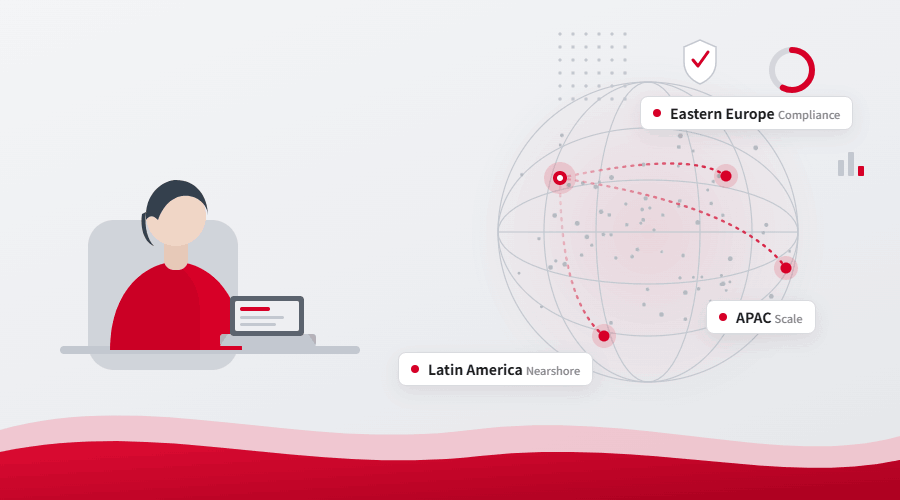
The Global Software Testing Outsourcing Landscape for North American Companies
Software testing outsourcing has evolved beyond its origins as a low-cost labor solution. This growth is driven by the gap created as AI coding tools accelerate development, while testing still requires human expertise, domain knowledge, and specialized skills that many internal QA teams lack the capacity to provide.
North America(*2) continues to be the largest consumer of outsourced testing services, while the provider landscape has become truly global. Companies now choose among three distinct outsourcing models, each with specific tradeoffs related to cost, time zone alignment, communication, and specialization:
- Nearshore: Partnering with a nearby country in a similar time zone, most commonly in Latin America, for US and Canadian companies.
- Offshore: Partnering with a distant country, most commonly in Asia, where labor costs are structurally lower, but time zone gaps are larger.
- A middle tier: Eastern Europe, which sits offshore geographically but nearshore in terms of overlap with European hours and often reasonable overlap with US East Coast mornings.
Understanding the strengths of each region, rather than relying on outdated stereotypes, is essential for making a sound, long-term outsourcing decision.
Why AI Is Accelerating the Outsourcing Decision, Not Replacing It
Many assume AI will eventually eliminate the need for outsourced QA. In reality, the opposite is occurring. Engineering teams using AI coding tools are producing code more rapidly, increasing the volume that requires functionality, regression, and edge-case testing. Internal QA teams, sized for pre-AI development speeds, have become bottlenecks in the release process.
As a result, more companies are increasing their reliance on outsourced QA rather than reducing testing budgets due to AI. AI is also redefining quality standards across all regions discussed. Providers with advanced AI-assisted testing capabilities, such as automated test case generation, self-healing scripts, and defect prediction models, are outperforming those that rely solely on manual processes. When evaluating regions and vendors, inquire specifically about their AI-assisted testing maturity, not just team size and hourly rates.
Three-Region Comparison: Latin America vs. Eastern Europe vs. Asia-Pacific
At a glance, here’s how the three regions stack up on the factors that matter most for a QA outsourcing decision:
- Cost: Asia-Pacific is generally the lowest; Latin America and Eastern Europe sit in a similar mid-range band, and both are still a fraction of US in-house QA costs.
- Time zone overlap: Latin America wins decisively for US-based teams, with most countries within one to three hours of US time zones.
- Talent depth and specialization: Eastern Europe has a long-standing reputation for technical depth within complex domains such as fintech, security, and legacy systems, built over two decades of serving Western European and US clients.
- Scalability: Asia-Pacific offers the largest talent pools by far, which matters if you need to stand up a 30-person testing team in a few weeks.
- English proficiency varies by country and region, but the Philippines, India, and most of Latin America score well, while parts of Eastern Europe and East Asia require more careful vendor vetting.
These factors are interdependent. For example, a fintech startup requiring daily standups has different needs than an enterprise conducting a six-month regression testing project with defined specifications and minimal live collaboration. The following sections provide a detailed analysis of each region.
Latin America: The Nearshore Powerhouse
Latin America has become the default nearshore answer for US companies, and the numbers explain why. Nearshore developer and QA rates across the region typically range from $30 to $90(*3) per hour, depending on seniority and country, with Mexico, Brazil, Colombia, and Argentina leading the pack. A senior QA engineer in the region generally costs 40% to 55%(*4) less than an equivalent US hire, while junior and mid-level testers can yield even greater savings.
Latin America’s key differentiator is its proximity. Most countries are within one to three hours of US time zones, enabling nearshore QA teams to participate in live standups, real-time sprint planning, and same-day bug report resolution. This time zone overlap leads to faster project completion, as feedback cycles remain short and efficient.
The region’s growth reflects this demand. Latin America’s nearshore IT and business services exports are expected to surpass $78 billion(*5), led by Mexico, Colombia, and Brazil. Unlike Eastern Europe and parts of Asia, where rates have declined slightly due to market saturation, Latin American rates have remained stable, indicating that companies are willing to pay a premium for proximity.
Latin America is less suitable for highly specialized testing domains such as embedded systems, aerospace, or legacy mainframe QA, where Eastern Europe has a more established track record. While English proficiency is generally strong in major urban tech hubs, it is advisable to assess individual teams rather than assume consistent fluency across the region.
The proximity advantage also enhances the effectiveness of AI-assisted testing. Latin American teams can participate in live sessions with product and engineering leads, allowing them to refine AI-generated test cases in real time based on actual product context, rather than relying solely on written specifications.
Eastern Europe: The Quality and Expertise Hub
Eastern Europe built its outsourcing reputation the hard way, by serving Western European and US enterprise clients on complex, high-risk projects for the better part of two decades. Countries like Poland, Romania, and Ukraine have deep benches of senior QA engineers who’ve spent years on regulated-industry projects in banking, insurance, and healthcare, and that experience shows up in how teams approach test design, documentation, and compliance-driven testing.
Rates in the region typically run $25 to $75 per hour depending on seniority and country, with senior QA automation engineers in Ukraine specifically, for example, generally falling in the $30 to $37(*6) range based on current contract data, while the broader Eastern European senior QA automation band runs roughly $27 to $45 per hour. That puts Eastern Europe in a similar cost band to Latin America, sometimes cheaper at the senior level, but the value proposition is different. You’re paying for testers who’ve likely worked on similar regulated or technically demanding systems before, not just for a lower hourly rate.
The primary tradeoff is time zone alignment. Eastern Europe aligns well with Western European business hours but provides only a limited window, typically early morning US Eastern time, for live collaboration with North American teams. For projects that do not require frequent live communication, such as structured test case execution with clear specifications, this is not a concern. However, teams seeking daily standups and rapid feedback will need to plan accordingly.
Eastern Europe also presents some geopolitical risks. Ongoing instability in parts of the region has led some companies to diversify delivery centers across multiple countries, such as Poland and Romania, in addition to Ukraine. It is advisable to discuss delivery center diversification with any Eastern European vendor.
Regarding AI-assisted testing, Eastern European teams typically focus on using AI to enhance test coverage for complex, rules-driven systems, rather than generating large volumes of new test cases. This approach aligns with the region’s emphasis on depth and thoroughness over speed.
Asia-Pacific: The Scalability and Cost Leader
Asia-Pacific is, by a wide margin, the fastest-growing region for software testing outsourcing, and it’s not close. Industry forecasts consistently rank APAC as the fastest-growing region in the global testing market, driven by massive talent pools, a mature outsourcing industry, and governments actively investing in digital infrastructure and STEM education. India solely accounted for a significant share of global QA service delivery volume in recent years, and countries like Vietnam and the Philippines have grown quickly as English-speaking alternatives with lower costs and expanding technical talent pools.
Rates are the most significant differentiator. Offshore development and testing in Asia-Pacific typically range from $18 to $50 per hour, the lowest among the three regions. Vietnam alone produces over 50,000 IT graduates(*7) annually, and offers competitive rates for both manual and automated testing. This combination of cost and scale makes Asia-Pacific ideal for rapidly building large testing teams or for projects where cost sensitivity is a priority.
The primary tradeoff is a significant time zone difference. Most Asia-Pacific is 11 to 14 hours ahead of US time zones, making real-time daily collaboration challenging. Experienced providers address this with a follow-the-sun model, where work is handed off at the end of the US day, completed overnight by the Asia-Pacific team, and returned by the next US morning. This approach effectively adds an extra shift to the release cycle.
Quality perceptions in Asia-Pacific have also evolved. The previous view of the region as primarily manual and checklist-driven is outdated. ISTQB certification is now widespread, and mature outsourcing providers have implemented advanced automation practices integrated into CI/CD pipelines. Asia-Pacific has also led to adopting AI-assisted testing tools at scale, enabling teams to achieve greater coverage and efficiency, further strengthening the region’s cost advantage.
Head-to-Head Comparison by Business Scenario
Rather than declaring one region the universal winner, here’s how the choice typically plays out by scenario:
- Fast-moving startup needing daily collaboration: Latin America. The time zone overlap supports the kind of live back-and-forth that agile teams rely on, and rates are still 40%+ below US hiring rates.
- Regulated enterprise (fintech, healthcare, insurance) with complex compliance needs: Eastern Europe. The regional track record on regulated industry projects and structured documentation practices reduces risk on high-stakes systems.
- High-volume regression testing or rapid team scaling: Asia-Pacific. Lower per-hour rates and large talent pools make this the most efficient region for quickly standing up a large team.
- 24-hour testing coverage across release cycles: A blended model using Latin America or Eastern Europe for live collaboration hours and Asia-Pacific for overnight follow-the-sun coverage.
- Budget-constrained project with flexible timelines: Asia-Pacific, where the lower hourly rate has the most room to work if daily real-time sync isn’t a hard requirement.
Time Zone Strategies for Each Region
Time zone overlap is not merely a convenience; it directly influences how a QA engagement should be structured.
In Latin America, the near-complete overlap with US time zones allows outsourced QA to operate similarly to an in-house team, including shared standups, live bug triage, and same-day feedback. This region presents minimal geographic friction.
For Eastern Europe, expect a smaller overlap window, usually in the first few hours of the US East Coast in the morning. Plan sprint planning and requirements handoffs during this time, then let the team work on their own. This works well for QA tasks with clear specs and little need for ongoing clarification.
In Asia-Pacific, the large time difference makes live overlap difficult and can tire out teams. Instead, set up the work for asynchronous handoffs, send status updates at the end of the US day, have the Asia-Pacific team work overnight, and review results in the morning. This can speed up release cycles by allowing testing to run while the US team is offline.
Quality Assurance Standards Across Regions
Quality is often misunderstood because of old regional stereotypes. ISTQB, the main testing certification body, has issued more than 1 million certifications(*8) in more than 130 countries. Certified testers are found in every region mentioned here, not just in one part of the world.
What really differs by region isn’t certification, but specialization and process maturity gained from years of working with certain clients. Eastern European teams usually have more experience with compliance testing for regulated industries, such as ISO standards, security, and legacy systems, because they’ve done this work for 20 years. Latin American teams are strong in agile, fast-paced testing, which suits the startups and scale-ups they’ve often worked with. Asia-Pacific providers, especially the big ones, have invested heavily in automation and AI-assisted testing tools, since their market values scale and efficiency.
The main point is to judge vendors by objective criteria, not just reputation. Ask about their ISTQB certification rates, automation coverage on similar projects, and client references in your industry. A good team in any region should be able to answer these questions clearly.
Making the Right Choice: Decision Framework
Before comparing vendors, answer these five questions honestly:
- How much real-time collaboration does this project actually need? If your team runs daily standups and expects same-day answers, weigh time zones overlap heavily and lean toward Latin America. If the work is spec driven with clear acceptance criteria, a wider time gap matters less.
- What’s the total cost of the engagement, not just the hourly rate? Factor in management overhead, onboarding time, and a realistic rework buffer. A lower hourly rate with more miscommunications can easily cost more overall than a slightly higher rate with a team that gets it right the first time.
- Does this project touch regulated data or complex compliance requirements? If yes, weigh the vendor’s track record and industry-specific experience over raw cost, and look closely at Eastern European and established Asia-Pacific providers with appropriate certifications.
- Do you need to scale a team quickly, or is this a steady, ongoing engagement? Rapid scaling favors regions with the deepest talent pools; steady, specialized work favors regions with the most relevant domain experience.
- How much of your codebase is now AI-generated? The more your development pipeline runs through AI coding assistants, the more your QA partner needs AI-assisted test generation and automation of their own just to keep pace. Ask any shortlisted vendor to walk through their actual AI testing tooling, not just their marketing language around it.
Most companies land on one of three approaches: an all-in nearshore approach with Latin America for speed and joint effort; a specialized Eastern European partnership for compliance-heavy work; or a blended model that combines a nearshore or Eastern European team for live collaboration with Asia-Pacific capacity for overnight coverage and cost efficiency at scale.
SHIFT USA’s Global Testing Advantage
SHIFT USA, the Palo Alto-based US arm of Japan’s SHIFT Inc., approaches this decision differently from most single-region providers because it isn’t limited to one region’s tradeoffs. North American clients get a local point of contact and US business-hours support, backed by SHIFT ASIA’s global delivery network. That combination gives SHIFT USA clients access to the SHIFT Quality Framework (SQF), ISTQB and ISO 27001-aligned processes, more than 4,000 projects delivered annually across the network, and a test criteria library updated daily across 900-plus benchmarks.
This combination is most valuable for companies that do not want to choose a single region and accept its tradeoffs. Clients with fast-moving products and daily release cycles benefit from real-time-capable delivery hours, while those with heavy regression or overnight testing needs can use follow-the-sun coverage through SHIFT USA’s global delivery network. All services are provided under a single quality standard and point of accountability, eliminating the need to manage multiple vendor relationships across regions.
This is also where SHIFT ASIA’s AI-Driven Development and Testing service, delivered to North American clients through the SHIFT USA partnership, directly addresses the code-velocity gap described earlier. Rather than treating AI as a separate tool bolted onto a traditional testing process, the service builds AI-assisted test design and automation directly into SQF, so the QA capacity actually scales alongside whatever pace your development team is shipping at, instead of falling further behind it release after release.
Conclusion
There isn’t one ‘best’ region for software testing outsourcing. Latin America is best for time zone alignment and fast collaboration. Eastern Europe stands out for specialized, compliance-heavy technical skills. Asia-Pacific is the top choice for cost savings and quick team scaling. The right choice depends on your product, your industry, and the level of real-time collaboration your QA process requires.
The most important thing is to make your decision carefully, based on your project’s needs, not just on what worked for someone else or what you find first online. If you get the basics right, like time zone strategy, quality standards, and a realistic view of total costs, any of these three regions can deliver great results.
References
1. Coherent Market Insights. “Software Testing and QA Services Market”
https://www.coherentmarketinsights.com/industry-reports/software-testing-and-qa-services-market
2. ThinkSys. “QA Trends Report 2026”
https://thinksys.com/qa-testing/qa-trends-report-2026
3. DistantJob. “Offshore Developer Rates”
4. BEON.tech. “Nearshore Software Development Rates”
5. Geniusee, citing IDB (Inter-American Development Bank). “Cost of Outsourcing Software Development”
https://geniusee.com/single-blog/cost-of-outsourcing-software-development
6. Lemon.io Rate Calculator. “Automation QA Engineer Rate & Salary 2026”
https://lemon.io/rate-calculator/automation-qa
7. Kyanon Digital, citing DxReports / FPT Digital “Digital Workforce Development Strategy.” “Vietnam’s IT Workforce: A Growing Industry with Endless Potential”
8. ISTQB. Official certification milestone announcement
9. Glassdoor. “Senior QA Engineer Salaries (US)”